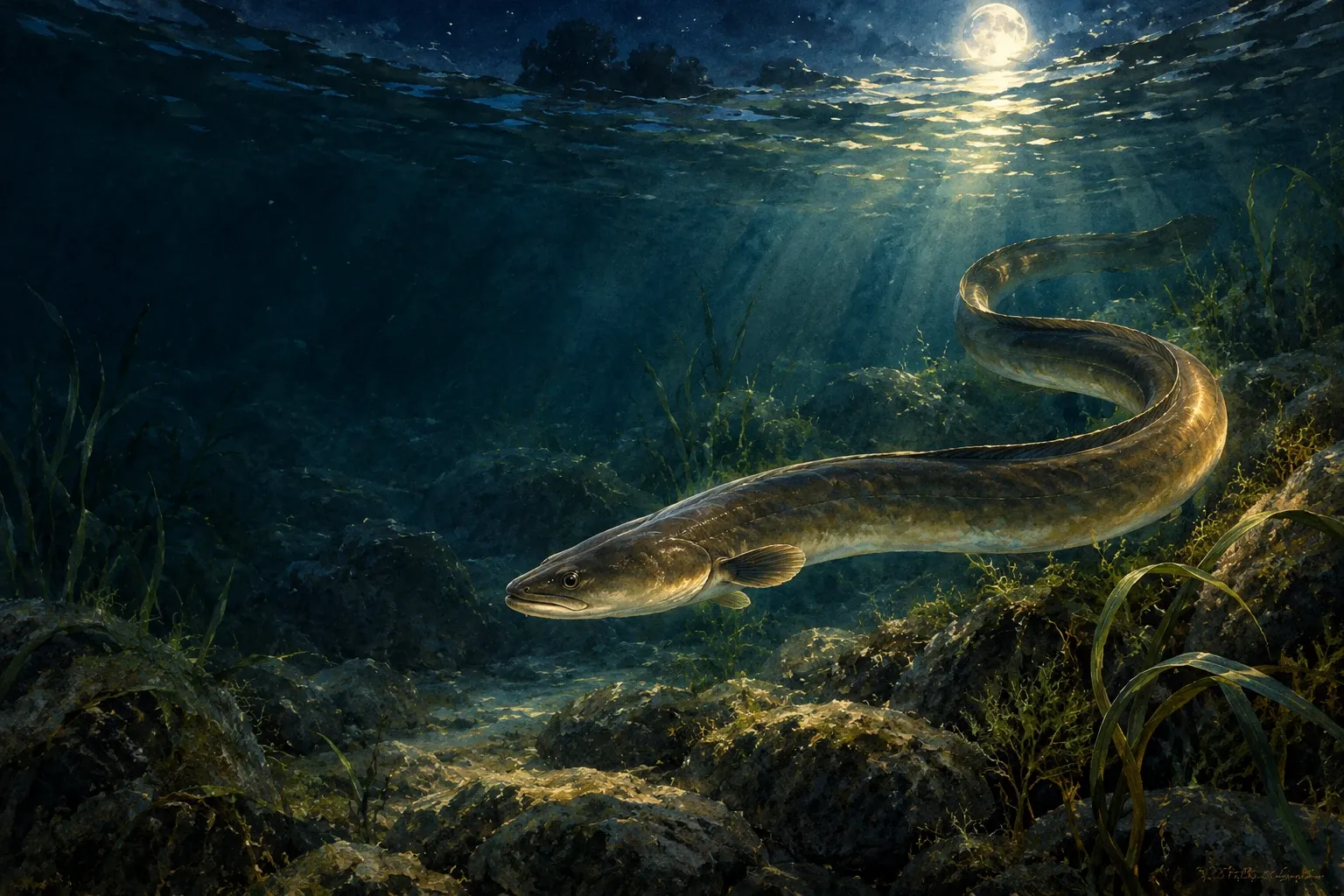
An eel lies quiet on a muddy riverbed through the day, its dark skin blending with the bottom. At night it slips out to hunt, moving in a swift, supple wave. Its long life leads through different waters: a nearly transparent young eel drifts with the sea, then some travel into rivers and lakes, and later return to salt water to reproduce. The eel’s meaning begins in that rhythm of waiting and passage. It teaches the strength of keeping still until the moment is right, then moving with all your life behind you.
The eel’s strength beneath the surface
The eel hunts by night and keeps close to the bottom, where its coloring helps it disappear. It relies on a keen sense of smell to find prey, and its powerful jaws and sharp teeth let it overcome creatures larger than itself. Its body bends through turns and narrow places; when the opening comes, it can move fast. The eel’s quiet is not emptiness. It is attention held in reserve.
When a hard season asks you to protect what is tender, the eel shows how concealment can serve life. Stay out of reach while danger is near; wait until the water clears enough to see your next move. Its lesson has another edge: if you have used your own slipperiness to deceive someone, name the harm and put it right. The eel knows how to vanish, but a life spent evading every truth leaves no clear path forward.
Some eels travel thousands of miles to reach their spawning grounds, crossing from familiar waters toward the sea. Their journey gives the eel a strong image of transformation: a life can change its surroundings and its form while following a deep current toward what it must do. The young eel’s translucent body drifts among the waves before it takes on pigment and enters coastal water. This beginning asks for patience with what has not yet become visible. A new purpose can take shape before anyone, even you, can make it out clearly.
The eel also carries a charge of spiritual energy in stories that connect its long, snake-like body with power coiled within. In Hindu thought, kundalini is described as a life force that rises from the body’s base toward awakening. The eel’s undulating movement makes a vivid image for that ascent: energy held close, then traveling upward through the body. Let the eel’s story speak of inner change as something to approach with patience and attention, not as a promise of wonders. It can be a season for noticing what is shifting and giving yourself time to live with it.
Eel kinship and the strength it lends
Some people carry the eel’s nature as a lasting kinship: depth beneath an unshowy surface, sensitivity to changes in the current, and a willingness to wait before acting. The eel is a bottom-dweller that hunts by scent and keeps to the dark, so its gift is not loud certainty. It is careful attention. When a task calls for a guarded approach, borrow that attention: watch what is happening around you, keep your energy close, and move when you can do so cleanly.
There are times when a journey draws you away from familiar ground. The eel’s passage between freshwater and salt water offers a companion for such a crossing. It does not demand that you see the whole route before setting out; it follows the pull of its season, one stretch at a time. And when you have spent too long waiting in a draining place, the eel’s speed lends resolve. Its body has spent its life finding a way through water; let yours find the opening and go.
The eel has another kind of strength in the stories told about its electrical relative. An electric eel uses pulses of electricity to navigate, though it is fairly blind. In this image, sensing is a form of direction: what first seems like a limitation can become a way to read the world. The eel’s power is not constant display. It gathers what it needs, then uses it with precision, for defense or attack. When you need to hold a boundary or act decisively, let that contained force be your guide.
Stories of eel, kinship, and protection
Hawaiians call the eel Puhi and recognize it as a spirit being related to their ancestors. The eel belongs to a world of living water, yet its presence reaches toward the family line and the unseen. In this kinship, the eel brings a sense of connection that moves beneath the visible surface, like a current that continues through generations.
In a Samoan story, Sina befriends an eel who is the King of Fiji in magical form. When the king grows old, he asks Sina to plant his head in the earth, and the first coconut tree grows there. The marks on the coconut resemble the eel’s face; drinking through one of its openings becomes a kiss to the eel. The story joins the animal to a tree that serves daily life, carrying a memory of affection into something people can hold, open, and share.
In a Melanesian story, Abaia is a great eel who guards the creatures of a freshwater lake as her children. When people threaten them, she lashes her tail and stirs up mud to hide them. Here the eel’s familiar gift of concealment becomes shelter for others. It watches from the water’s depths, then acts when its charges are in danger.
Celtic stories tell of eels that could change form, grow legs, and walk on land before returning to the sea. The eel’s passage between worlds gave it a place in tales of wisdom, adaptation, and protection. The old stories understood what the animal’s body makes plain: a creature that can bend, vanish, and travel between waters is hard to confine to one shape.
What an eel may mean in dreams
An eel moving through a dream may point toward a time that asks for flexibility. Its body bends along the path rather than forcing a straight line through water. If the eel is moving, change may already be under way; keep your senses alert and adapt as the way ahead becomes clearer.
Two eels together may suggest romance or the beginning of a friendship. If you try to catch an eel and it escapes, the dream may speak of an opportunity that has slipped from reach. The image has urgency: the eel moves quickly, so notice whether there is still a way to return to what you meant to grasp. An eel can also carry associations with fertility or attraction, particularly when those themes already have a place in your waking life.
The eel leaves no straight trail. It waits beneath the mud, feels its way through the dark, and crosses from one kind of water to another. Carry that image with you: below the surface, a patient body is already turning toward the sea.