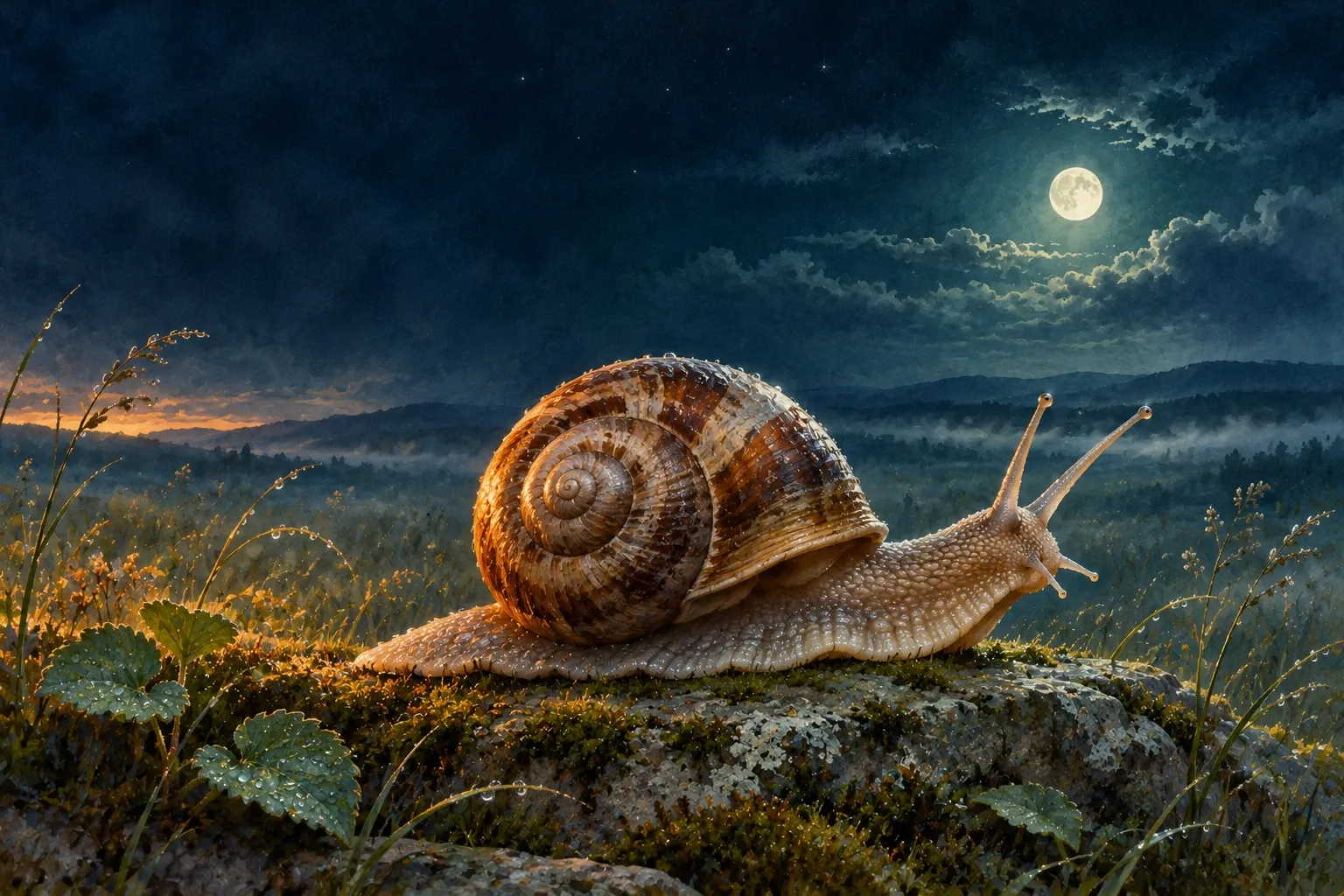
After rain, a snail eases from the damp earth, feelers testing the air while its shell travels with it. The garden has changed in the night: leaves shine, soil loosens, and a familiar path leads toward food. Snail does not cross that ground by force. It keeps close to the earth and continues at its own pace. Its teaching is simple: protect what is tender, pay attention to the way ahead, and trust the small movement that begins a new path.
Snail’s patient way through a hard season
A snail carries its home on its back. When conditions grow harsh, it can draw inward; when the way becomes livable again, it comes out to feed and move. This is no grand escape. It is a creature’s own way of keeping itself safe while the world passes through its weather. Snail teaches the wisdom of knowing when to withdraw, quiet the mind, and conserve strength.
Its slow travel has another kind of purpose. A snail feels its surroundings with its tentacles and leaves a trail as it moves. Its pace gives it time to meet the ground directly, one stretch at a time. When life has become crowded or hurried, Snail’s message is to slow down enough to perceive what is already near: the opening in the hedge, the path that has become too narrow, the place where you can pause without losing your direction.
Some people recognize this nature as a lifelong kinship: self-sufficient, cautious, and determined. Others meet Snail during a season when privacy matters, or when an old route has stopped leading anywhere worth going. Either way, it offers a strength suited to the task at hand. For a difficult undertaking, let persistence be smaller than ambition: take the next step, then the next. For a needed retreat, draw inward without mistaking rest for defeat. A shell protects the snail, but it also travels with it; shelter can be something you carry into the next beginning.
The spiral and the return of spring
Look at a snail’s shell and the eye follows its spiral inward, then outward again. It is a fitting sign for a creature that retreats and emerges, hides and resumes its journey. Snail holds both movements together: turning inward to recover what is true, and opening outward when it is time to begin again.
The snail is associated with beginnings, emerging from the soil in spring. Its return is quiet, close to the ground, and easy to overlook if you expect every new chapter to announce itself. But the first movement counts. Snail teaches that a fresh start can begin with a small change of direction, a protected thought, or one careful step toward what will nourish you.
In the ancient Mexica world, Snail was sacred and represented the cycle of life. The moon god Tēcciztēcatl was shown with a snail shell on his back. The snail’s retreat into its shell recalled the Moon sinking into the ocean; the image held withdrawal and return within a single form. The feathered-serpent god Quetzalcoatl also wore a snail-shell emblem on his chest, associated with reincarnation and the cycles of the universe. These are particular sacred images, with meanings shaped by their own tradition. They echo the snail’s visible rhythm of drawing in and coming forth again.
When a snail appears in a dream
A snail drawing into its shell may point toward a need for privacy or a pause from demands. The animal’s shelter is close at hand, and its retreat is a way of protecting its soft body. If the dream leaves you with that image, consider what part of life needs quieter conditions before it can emerge again.
A snail moving steadily across a leaf or stone may suggest progress that feels modest but is still carrying you forward. Its pace belongs to its body; it does not need to borrow another creature’s speed. A snail that cannot move, or whose shell is cracked, may bring the image of exposed vulnerability: protection feels strained, or the path ahead has become difficult to cross. These are possibilities, not fixed meanings. In each scene, the snail remains itself: sensitive to its surroundings, sheltered by its shell, and capable of continuing when conditions allow.
The shell’s voice across the water
The land snail’s home has a louder relative in the conch, a large sea snail. A shell can be a dwelling, an ornament, or an instrument whose sound reaches beyond the creature that formed it.
At Teotihuacan, conch shells adorned ruins and were included in tombs; ancient Maya artists also used shells. The conch’s voice gives another shape to Snail’s teaching. The creature that spends much of its life close to the ground can still be linked with a sound that carries outward. Quietness does not mean having nothing to say. Sometimes a message gathers within, protected for a time, until it is ready to be heard.
The snail returns to the damp path, carrying its shelter and leaving a fine trail behind. It knows the strength of a slow crossing and the value of a safe place to withdraw. Keep its small spiral in mind: turn inward when you need to, then come forth when the earth is ready beneath you.