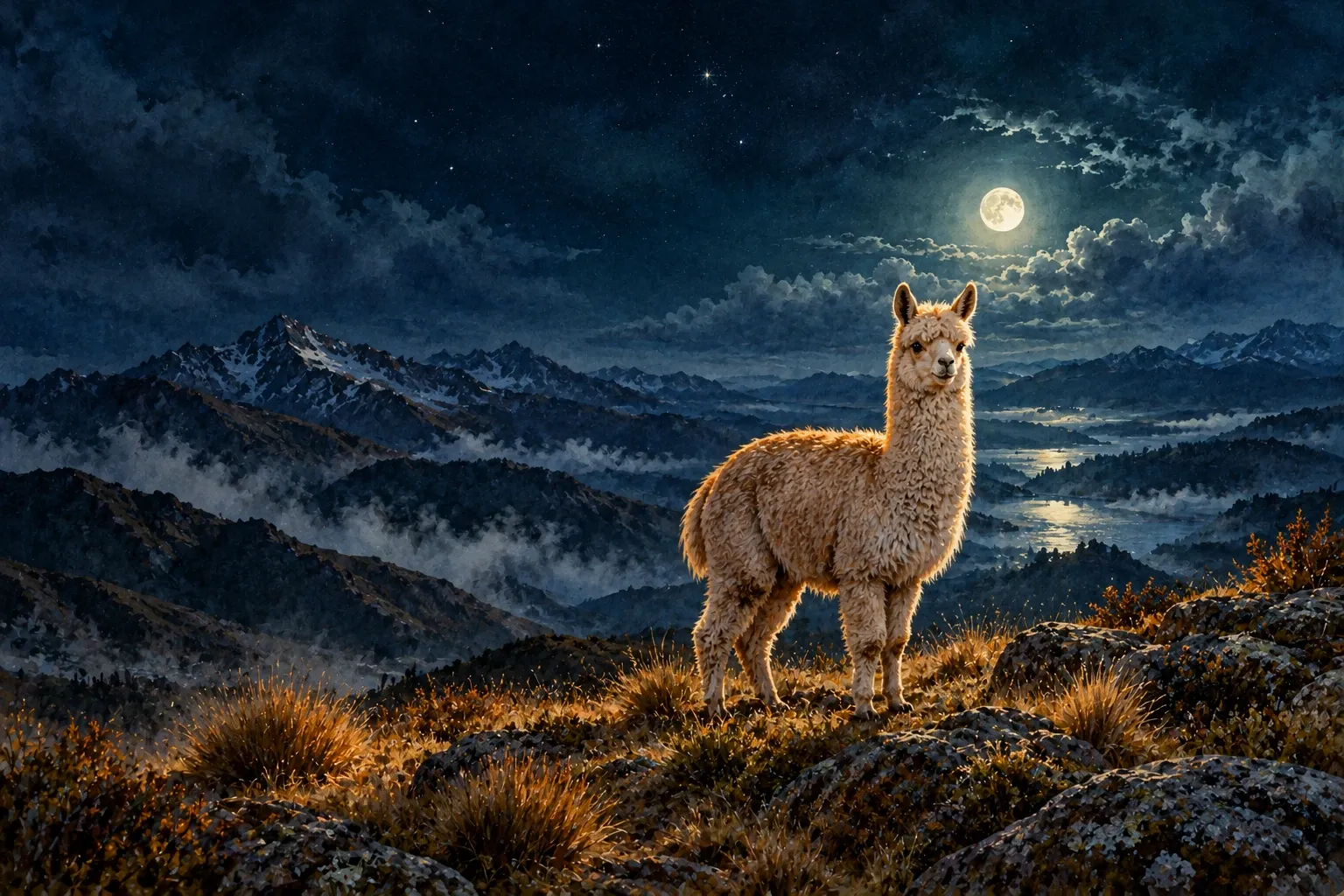
An alpaca lifts its head from the grass, ears alert, and gives a soft hum that carries to its companions. If something startles the herd, its call sharpens; if a burden grows too heavy, it plants its feet. Here is the alpaca’s meaning: stay close to those who share your path, speak when something is wrong, and do not confuse endurance with carrying more than you can bear.
The alpaca’s quiet strength
Alpacas graze in the high Andes, where grasses grow sparsely and the weather can turn hard. Their thick fleece keeps warmth near the body. For thousands of years, Andean people have tended alpacas for their fiber, shaping a relationship in which the animal’s daily life and human work meet. Alpacas were fully domesticated by Andean people centuries before the Incas.
That long companionship lends the alpaca a meaning rooted in useful care. Its fleece becomes clothing; its presence belongs to a herd and to the people who tend it. The animal does not hurry to prove its worth. It feeds, stays among its companions, and gives what its nature can give. When the alpaca appears as a spirit animal in a demanding season, it asks you to notice what your steady work sustains. Keep at the task that matters, but take stock of its weight as you go.
The alpaca’s coat also holds a lesson in difference. Huacaya fleece grows dense and crimped; Suri fleece hangs in long, lustrous locks. One gathers into a cloud, the other falls in shining strands, each distinct and well suited to its own form. Let the alpaca remind you that a gift need not look like anyone else’s to be of use. Your nature has its own texture; tend it with patience.
An alpaca communicates without a grand display. A low hum, the tilt of its head, or the position of its ears can tell the herd what is happening. At a sign of danger, it raises a sharper alarm. When irritation builds between alpacas, a spit can make the complaint plain. The animal’s message is direct: say what matters while you can still speak clearly. A calm warning can protect a bond; swallowed words can leave the trouble to grow.
The herd and the long road
An alpaca is a social animal, safest among its own kind. It does not thrive alone. This makes its totem a natural kinship for people who are attentive to the well-being of a group: the friend who checks whether everyone has arrived, the worker who sees where another pair of hands is needed, the one who remembers that a shared road calls for shared care. Your steadiness matters most when it helps the whole herd move well.
There is a boundary in the alpaca’s nature, too. When a pack animal is overloaded, it may refuse to move until the burden is adjusted. The alpaca’s stillness is not laziness; it is a clear sign that the load has passed its measure. When work gathers faster than you can carry it, name the weight and ask what can be changed. Call on the alpaca’s strength for a long effort: accept the work that is yours, protect the strength you need to finish it, and let others take their share.
The alpaca’s quiet persistence also belongs to the person who has set aside a worthy aim after a discouraging season. Alpacas endure in a demanding landscape by continuing to graze and travel with the herd, one stretch at a time. Begin again with the next sound step. You need not race ahead to prove your resolve; the animal’s steady pace is its own kind of courage.
Andean stories of the camelids
The alpaca lives within a wider Andean history of camelids, though old stories often name the llama specifically. In Inka tradition, people honored a llama deity called Uruchillay, who watched over animals and the herds on which herders depended. Another story tells of llamas watching the stars and warning two brothers that a flood was coming. The brothers led their families into the high Andes, where they survived as the waters covered the land. In a Peruvian telling, a llama warned a man to reach a mountaintop before the sea rose. These are stories of watchfulness and survival: the herd sees a change in the sky, and people who listen find shelter.
An alpaca-shaped stone vessel from Inka Peru, made around 1500, gives the animal a place in the surviving art of that world. Set beside the camelid stories, the small carved form carries a quiet reminder of how closely these animals belonged to Andean life. The alpaca’s meaning here is not a single teaching shared by every people, but a lasting bond between animal, land, and those who cared for the herd.
Alpaca dreams and their signs
An alpaca walking down a road points toward trust in the path and the patience to keep going. If a group of alpacas travels together, the dream turns toward cooperation: something important moves forward when each person keeps pace and carries a fair share.
An alpaca bent under a heavy load brings the question of burden into the dream. The image may point to responsibilities or old worries that have accumulated past their proper weight. Remember the animal that stands still until its load changes; some part of the dreamer’s life may be asking for a truer measure.
If an alpaca spits in your direction, the image suggests displeasure or a strained bond. Its plain signal points toward a grievance that needs honest words. An alpaca lying down can signal a pause, a setback, or a moment when progress has stopped. Let the dream’s stillness register before expecting the road to open again.
The alpaca’s strength is not a roar across the mountains. It is the hum that keeps companions near, the alarm that makes the herd look up, and the firm feet that refuse an impossible burden. Picture one grazing beneath the wide Andean sky, its coat stirring in the cold air, listening for the answer of its companions. It teaches that a long road is made more bearable when the herd stays close and every load has its measure.