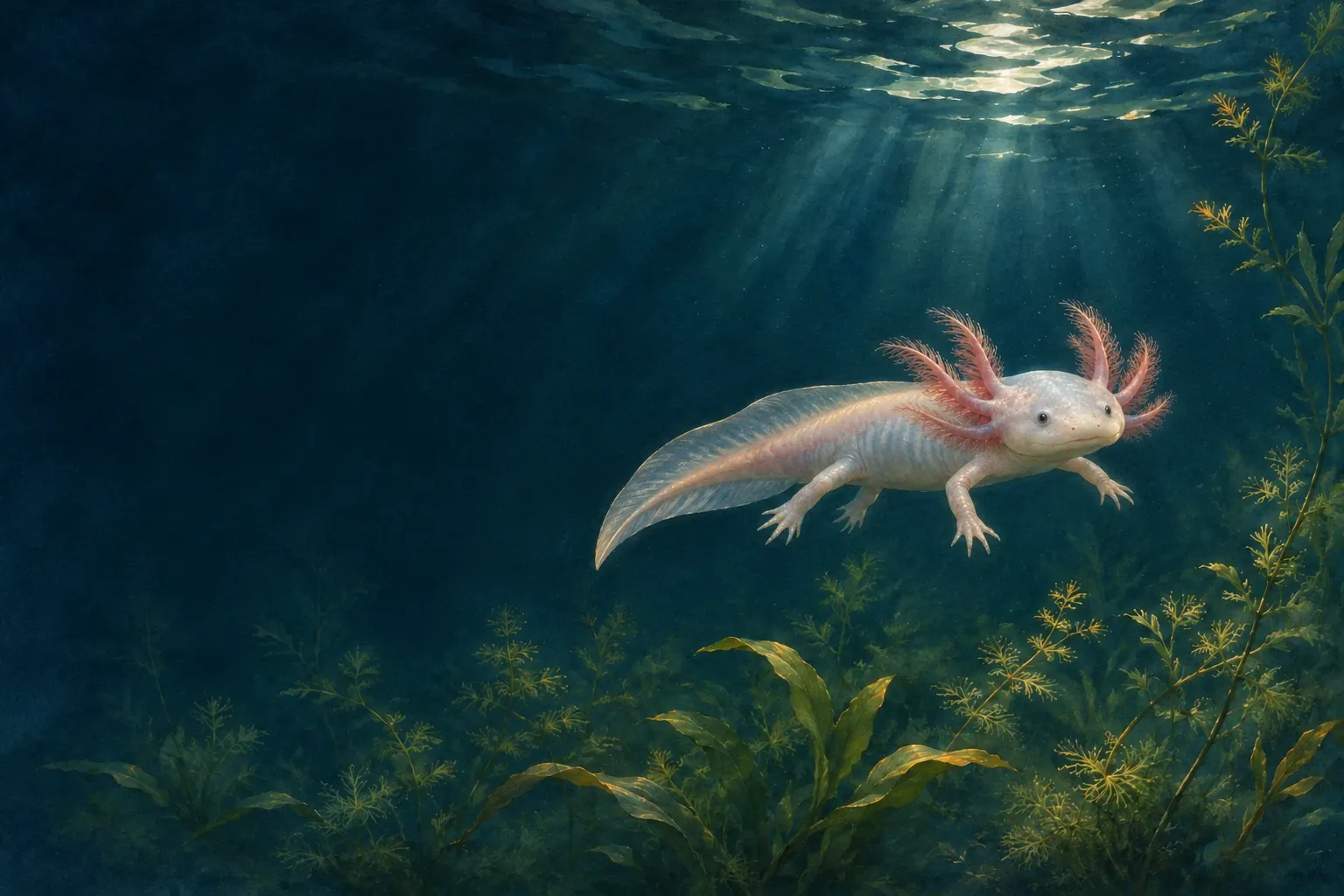
The axolotl drifts above the lake bottom, its feathery gills fanning beside its head like small branches in a current. It is an adult, yet it keeps the shape of youth and makes a whole life in the water. When part of its body is lost, it can grow it again. Its spiritual meaning begins there: renewal with patience, a life held close to its own element and made whole piece by piece.
The life the axolotl keeps
An adult axolotl keeps larval features, including feathery external gills and a tadpole-like dorsal fin. It can reproduce while keeping those features. Its soft frills stir in the water as its four feet carry it along the lake bottom. This is an adult life complete in the shape it keeps, each movement made for the element that has held it from the beginning.
The axolotl can regenerate a lost limb. Its body answers injury by rebuilding, with no need to become another creature first. That work gives the animal its quiet emblem of restoration: a missing part returns in its own time, fitted to the life that remains. The little swimmer does not hurry toward a different form to prove that it has grown. It stays itself and carries on.
When the axolotl comes near in a season when you feel torn apart, let its steady life set the pace. It stays in its lake and continues in its own form; it lends hope in repair, one small part returning at a time. Trust the slow work that belongs to you, and measure your healing by your own stride. The creature’s lesson is not a grand leap from one life to another, but the patient tending of what is still here.
Kinship in the water
The axolotl is often solitary, yet it is no creature of hard edges. Its small, watchful body moves through the water with its gills fanning as it feels its way along. A lifelong kinship with this animal belongs to a nature that can be tender and durable at once: the youthful face paired with the strength to endure, the quiet creature alert to what surrounds it. Its way is curious, gentle persistence.
The axolotl keeps its youthful look into adulthood. There is a kind of wonder in that: bright attention lives alongside the hard work of surviving. Let that kinship steady you when adulthood feels like a demand to grow severe. Keep your curiosity alive; let play and seriousness share the same day. A child’s wonder does not make the animal less capable of enduring; its small, open face belongs to a creature with a strong will to live.
When a task calls for strength, the axolotl lends the resolve to stay with the work of mending. Its body does not leap over injury; it grows what is missing. Keep its image close when a project, a bond, or a difficult season asks for patient attention. Begin with the part you can tend today. The axolotl’s power lives in carrying on in the form that is yours.
When the axolotl visits a dream
An axolotl in a dream brings water and change together. Its strange, familiar shape can mark a passage in which something old falls away and new growth begins. The image carries a particular stillness: the animal keeps its youthful form into adulthood, living its life without the expected change into a land salamander. A dream of this lake-dweller can set the mind beside a kind of change that does not demand a new outward shape.
If the axolotl stares at you, the dream turns toward a pause. You may be staying where you are, and the rest of the scene can show whether that stillness feels safe or unsettling. Murky water gathers a sense of concealment around the animal, as if someone nearby is keeping something close. An axolotl moving happily beside another brings the dream toward companionship and a bond taking shape. Its gaze, the water, and its company give each dream its own current.
Xólotl and the Fifth Sun
In a Nahua story of the Fifth Sun, Nanahuatzin casts himself into the fire and becomes the Sun; Tecuciztécatl follows and becomes the Moon. The two lights appear in the sky, waiting for movement. The gods must offer themselves so the Sun and Moon can begin their courses. Xólotl fears his turn and flees.
He hides among the maize and becomes a double stalk called xólotl. He runs again, hides among the maguey, and becomes the double plant mexólotl. Then he plunges into the water and becomes the fish called axólotl. They find and kill him. With the gods’ sacrifice, the Sun begins to move and time begins its course. Xólotl is the deity who takes these shapes; the axólotl is the water creature that bears his final form in the tale.
The fleeing god’s path runs through the fields and into the lake: maize, maguey, axólotl. The creature’s name enters the story at the water’s edge, where Xólotl’s flight ends and the Sun’s journey can begin. The little animal carries a story of the threshold between stillness and motion, and of a life that takes shape in water after a long flight.
Xólotl and human beginnings
In a separate Nahua story of human beginnings, the earth-gods choose Xólotl as their messenger to the place of the dead. Xólotl obtains a bone of superhuman dimensions. Mictlantecutli pursues him; falling in his flight, Xólotl breaks the relic into pieces. Xólotl gathers the pieces and leaves the subterranean world.
The gods place the bone in a vessel, and each gives blood. On the fourth day a boy emerges; four days later a girl rises from the vessel. Xólotl guards the children and feeds them the milk-like juice of the maguey. They grow into the first man and woman, progenitors of the human race. Their descendants differ in stature as the bone fragments differed in size. Here Xólotl brings human beginnings back from the land of the dead and tends the first children.
The two children’s beginning is tender and strange: broken bone, blood, a vessel, then the small bodies that will become parents of a people. Xólotl’s part in this tale is that of messenger and guardian. He carries the precious relic back, then stays with the children as they grow. The axolotl is not Xólotl, and the children’s story is not the fish’s transformation; both stories hold their own place in Nahua telling.
The axolotl in a living culture
In the Basin of Mexico, people once used axolotls as part of their diet. The animal belonged to daily life as well as to Nahua stories, its strange shape at home in the lake and in the imagination. Its place among the people of the basin was not only a matter of myth: it was also a creature encountered in the waters that shaped life there.
February 1 is Mexico’s National Axolotl Day, declared by the Senate in 2018. The day honors the axolotl’s place in Mexican ecosystems and cultural identity. Its life remains bound to the water: soft gills fanning above the lake bed, each frill moving with the current. Renewal can be quiet. It can begin right where you are, like the axolotl easing forward through the lake, whole in its own strange and lasting shape.