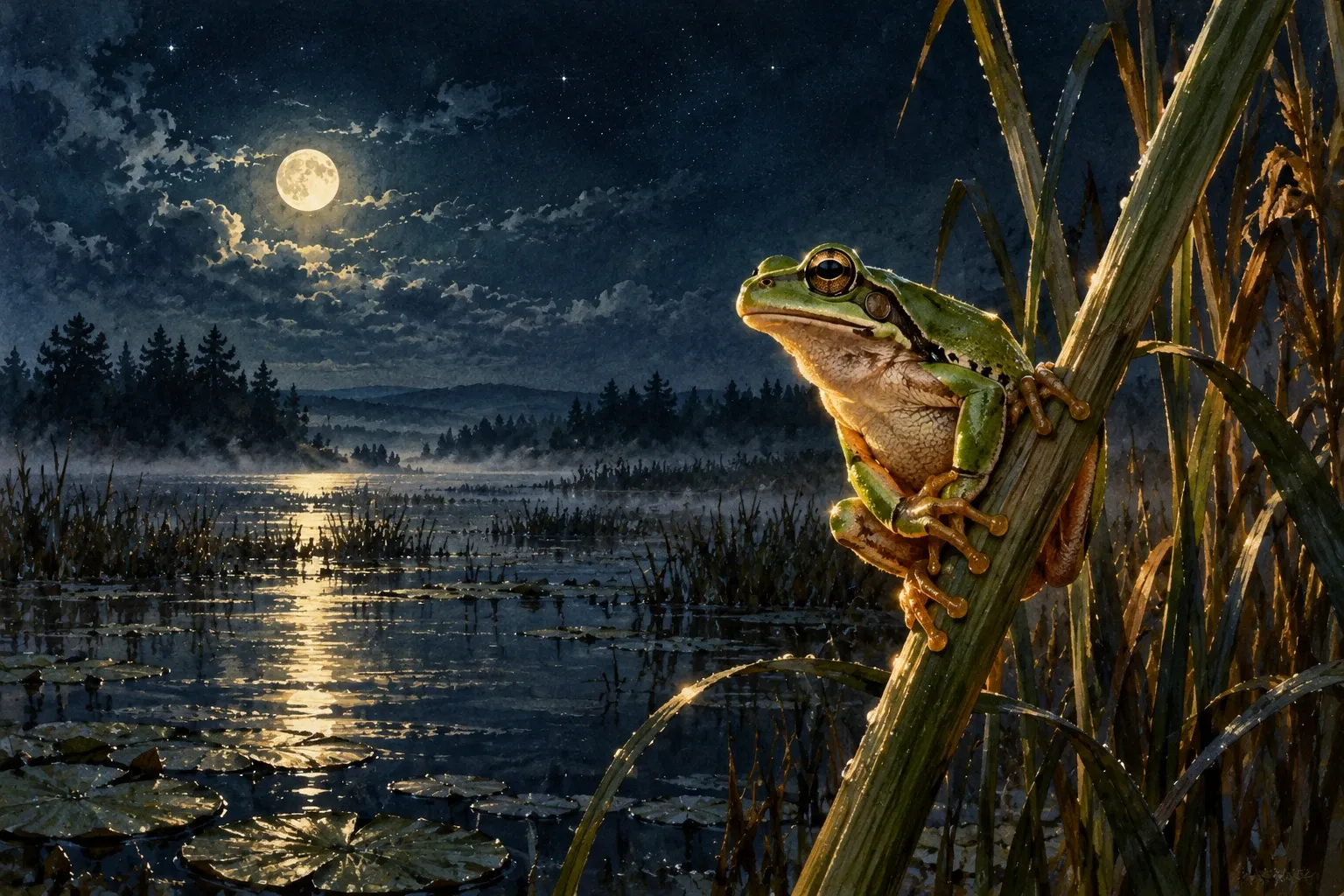
A frog begins as an egg in water, becomes a tadpole breathing through gills, then grows legs and climbs onto land. Still, the grown frog keeps close to water, returning to it throughout its life. Frog knows both the pond’s depths and the ground beyond its edge. Its central teaching lives in that passage: let change carry you toward a new way of being, while staying close to what nourishes you. When the spring calls begin, Frog raises its voice as if the whole wet earth were ready to answer.
Frog’s call clears the water
A frog’s call does practical work. It can draw a mate, mark a territory, or warn of danger. Its voice travels across the water, distinct and sure. Frog asks you to speak with that same clear purpose. Tell the truth that has been gathering in you. When feeling is hard to put into words, give it a rhythm: sing, chant, or let tears come. Sound can carry emotion toward release.
Water is tied to feeling, and a frog needs a healthy, damp place to live. Its life reminds you that emotion can feed growth, but stagnant water needs renewal. Clear what has become harmful in your daily life or relationships. Frog’s teaching is to recognize what drains your strength, then let it go. The frog’s own skin is porous and its health reflects the water around it; in this way, it stands as a living sign of how closely a creature’s well-being depends on its home.
Frog also teaches that transformation takes stages. Egg, tadpole, and adult are not separate stories, but parts of one life. A new beginning may first look small, awkward, or unfinished. Stay with the becoming. The tadpole does not leap onto land before its legs are ready. When the time comes, Frog can spring many times its own length, carrying itself across mud and water in a single motion.
Frog’s kinship grows through change
Those with a lifelong kinship to Frog are often sensitive to the emotional weather around them. A frog’s hearing is tuned to sound and its calls answer the living world nearby. Keep that kind of attention: listen for what is spoken and what is held back. Care can be expressed in a few well-chosen words, or in knowing when to be quiet. Frog’s closeness to water also keeps feeling connected to the body and to the steady earth beneath your feet.
Frog’s many eggs and its return with spring rains have linked it with fertility, family, and abundance. Its life speaks to the arrival of a child, a new idea, or a new way of seeing. When someone reaches a milestone, Frog’s passage through distinct stages offers a companion for the struggle of becoming. It teaches patience with a change that cannot be rushed, and confidence that a new form can emerge from an unfamiliar one.
When a task calls for courage, call on Frog’s voice and leaping strength. Use them when you need to state what matters, begin a venture, or move away from what has become toxic. Frog pairs compassion with action: hear others closely, then speak plainly and take the next step. Its rain-song clears the ground; its leap crosses it.
Frog dreams move from pad to pad
A frog moving from one lily pad to another carries a particular image: a succession of brief landings. Such a dream can point to frequent changes in home, work, or relationships, or to a life in which you move on before a place feels settled. The pads are real resting places, yet each one is small and separate. The dream may ask whether your present movement is carrying you toward firmer ground.
A frog’s movement in a dream matters. Is it crossing water, emerging from mud, or holding still? The animal’s life links water with feeling and growth, and its change from tadpole to adult offers an image of transformation. A frog emerging from mud can suggest new life after a difficult passage. Let the dream’s setting and action shape its meaning; Frog’s song is never separate from the water and earth that answer it.
Frog’s meanings travel by distinct paths
Ancient Egyptians connected frogs with abundant life. Each year the frogs returned as the Nile flooded, leaving fertile silt across the land. The tadpole also served as a hieroglyph for the sacred number one hundred thousand, a figure that echoed the abundance of their many young.
Hindu tradition honors Frog as a deity and hears its croaking as a form of chanting. During drought, priests pray to Frog for rain. Hindu stories also credit Frog with projecting the planet into orbit around the Sun, joining its voice to cosmic wisdom.
In China, stories associate the money frog with wealth and good fortune. Chinese and Japanese families may give new parents a ceramic frog. In Japan, travelers carry frog amulets for a safe return: kaeru, the Japanese word for frog, also means “return.” Japanese frog amulets also accompany people seeking fortune and safety on the road. These customs hold distinct meanings in Frog’s associations with prosperity, family, and the journey home.
Celtic stories placed frogs near sacred wells and rivers, where they carried meanings of healing and cleansing and were called rulers of the Earth. Zuni, Tlingit, Creek, and Chippewa communities have Frog clans; the teachings of each community belong to its own tradition. No single story can stand in for them all.
Frog sings from the border of water and earth, where renewal first stirs. The rain loosens the mud; the small creature grows into a leaper. Keep Frog’s teaching close: clear the stagnant water, speak with purpose, and when your new legs are ready, leap toward the ground that can hold you.