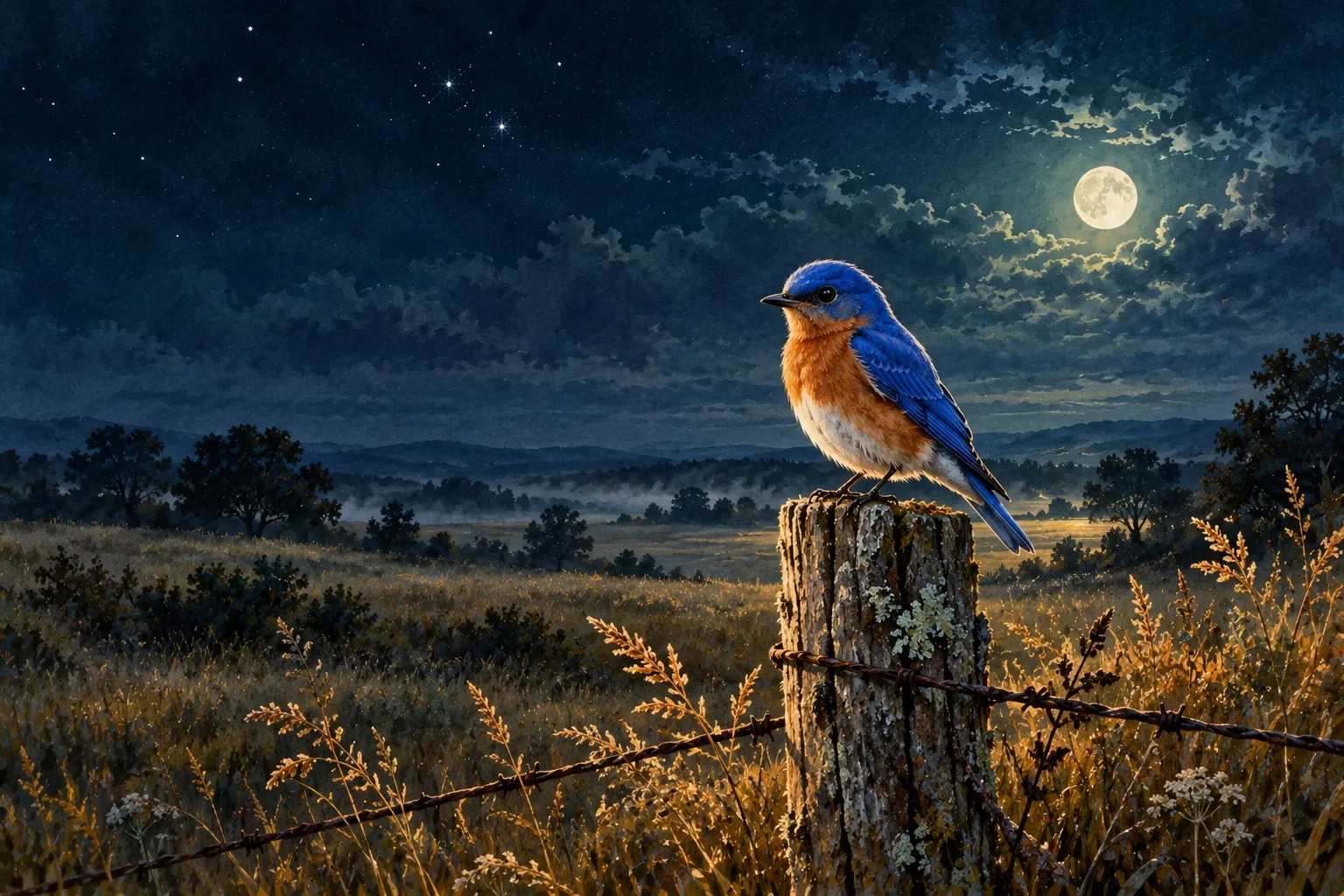
A bluebird sits on a fence post, its bright back against the open sky. It watches the grass, drops to the ground, and rises with a beetle in its beak. Then its song carries across the yard. This little bird’s teaching is clear: happiness grows when we notice what is near, speak in our own voice, and share the good we find.
The bluebird’s song through changing seasons
Bluebirds perch on wires, posts, or branches and scan the ground for insects and berries. They make their nests in tree cavities, often in holes left by woodpeckers. Their bright color catches the eye, but their modest manner and clear song give them a quieter kind of confidence. Together, those qualities have made the bluebird a companion to hope, contentment, and the pleasure of ordinary things.
A bluebird’s meaning gathers strength at the turning of a season. In Pueblo country, bluebirds descend to lower ground in winter cold, and their movement between winter and summer became an image of passage and renewal. Their feathers also appear in Pueblo rites connected with snow and ice, whose melting water nourishes spring growth. The bird’s return belongs to the world’s actual changes: cold loosens, ground warms, and new life begins. When your own season changes, meet it as the bluebird does—alert to what is opening, steady in your small daily work.
The bluebird’s familiar association with happiness also lives in a European fairy tale. The story echoes the bluebird’s own way of making a small patch of the world brighter: a song, a flash of blue, a bird returning to its nest.
A gentle nature with a brave heart
Bluebirds do not bully other birds, but they defend their nests when threatened. That balance belongs to the bird’s deeper meaning: gentleness can stand firm. Its nest, tucked into a cavity and tended with care, is a picture of the safe place we build for the people we love. Its bright song is an open call to company; its courage rises when home or young are at risk.
When the bluebird finds you in a hard season, it brings your attention back to the joys that daily burdens can hide. The bird keeps searching for food and tending its nest, and it sings along the way. Let its song remind you that gladness can live beside responsibility. You do not have to wait for every task to be finished before you notice a flower, welcome a friend, or take pleasure in a quiet hour.
For a person who has felt a lifelong kinship with the bluebird, the bird’s nature points toward warmth, modesty, and devotion to home. Bluebirds return to familiar nesting places and make their presence known with song. Their way speaks to someone who welcomes others, offers a steady place to belong, and protects loved ones when danger comes close. When a task calls for courage, take the bluebird’s strength: hold your ground without letting harshness become your first language. It is gentle by nature, and still willing to put a larger bird to flight when its nest is threatened.
The bluebird in stories of land and sky
Cherokee tradition connects the bluebird with weather and the direction of the winds. Iroquois stories hear its song as a sign that Tawiscaron, Old Man Winter, will pass. In these traditions, the bird’s call belongs to a particular turning in the natural world: wind shifts, cold gives way, and another season approaches.
Navajo tradition links the Mountain Bluebird with the sun; a bluebird song at daybreak calls people to greet the morning. Hopi tradition places the bird as a guardian of the West, where sky meets earth. Each people gives the bluebird its own place in a living order, and the bird’s color, song, and arrival carry meanings shaped by that place.
An Ojibwa story tells how two bluebirds, chasing one another in play, flew through the paint Nanabozho had spread across the new earth. They carried color on their feet and feathers toward a roaring waterfall. Mist lifted the paint into the sky, and sunlight made a rainbow. The birds’ play left a gift for everyone who looks up after rain.
The bluebird holds two kinds of joy together: the happiness we discover close by and the happiness we make by giving. Its meaning travels in a voice that can be heard by someone beyond the nest.
When a bluebird comes into a dream
A bluebird appearing in a dream can mark a struggle beginning to ease, with relief returning after a difficult stretch. If it calls to you, the image may point toward something a caring friend or family member wants to say. A bird that appears and vanishes quickly carries the reminder to value good fortune while it is present. The dream does not promise what comes next; it leaves you with the clear sight of a small bird, here for a moment, then gone from view.
The bluebird’s teaching rests in its daily acts: watching the ground, finding food, keeping its nest, and lifting its voice. Its happiness is not a far-off prize. It begins in the life around you, bright as a blue back against the sky, and grows when the song is shared.