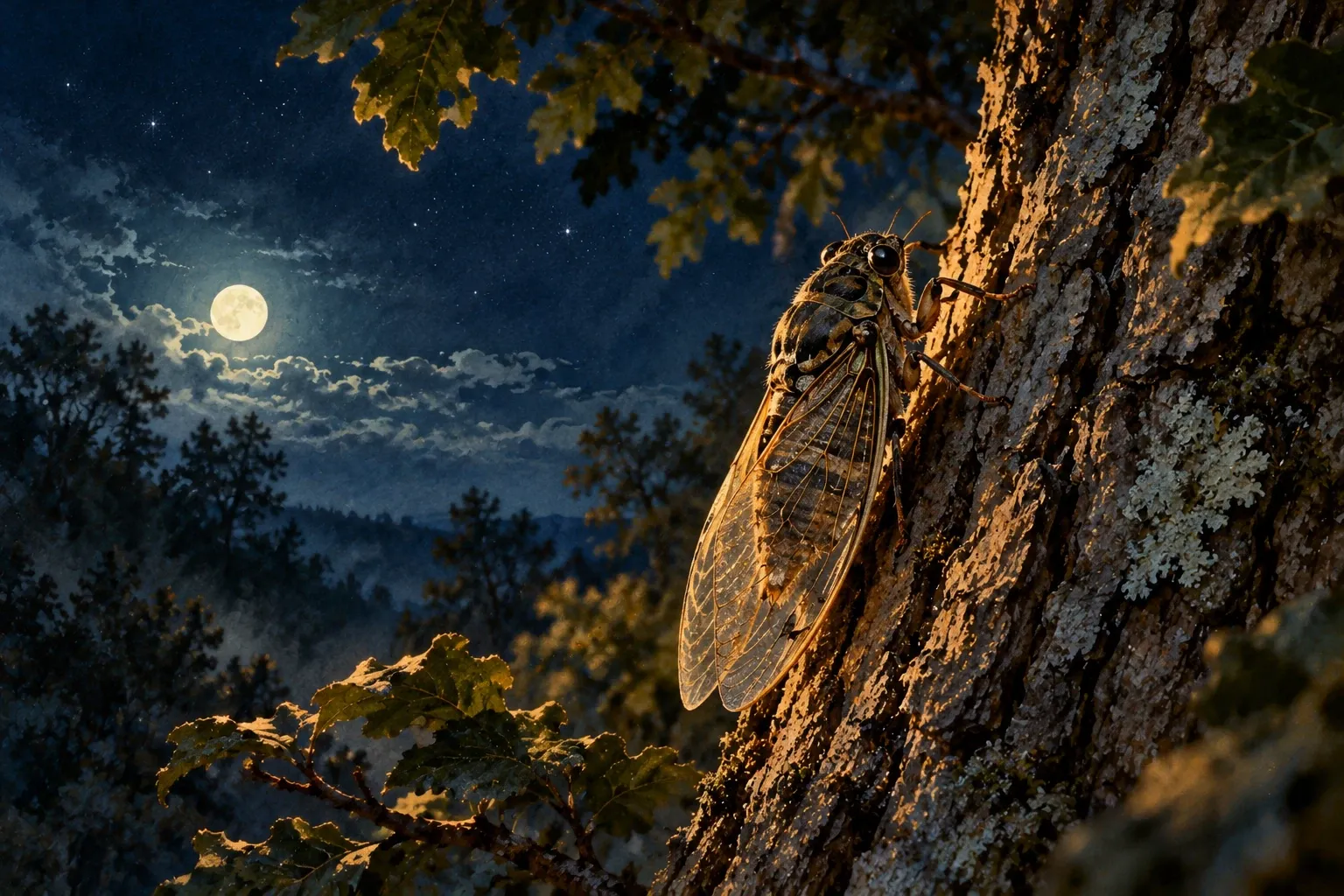
A cicada can spend years below the ground, close to the roots, while the world above it changes through season after season. Then the soil opens, and it climbs a tree. Its wings dry; its old casing stays behind on the bark. Soon the warm air rings with its call. The cicada’s teaching is plain: patience has its season, and when the time comes, give your own voice fully to the world.
When the cicada calls you into the light
The cicada spends a long stretch of its life hidden underground. Some kinds return to the surface each year; periodical cicadas wait thirteen or seventeen years. Their patient timing makes the sudden chorus feel like a whole season waking at once. When the cicada becomes your spirit guide for a season, it speaks to the end of waiting. A skill or truth you have kept private is ready to be heard. The cicada does not rush its growth, but it does not keep its song underground forever.
The cicada’s call comes from special organs on the male’s body, and its hollow abdomen amplifies the sound. That small body can send a song across a neighborhood or forest. Let this be the cicada’s counsel when you have something worth saying: prepare your voice, then let it carry. Speak with purpose, and listen for the rhythm that is truly yours. The cicada sings to attract a mate, so its loudness serves a living purpose; it is not noise for noise’s sake.
When the cicada climbs free, it leaves its old exoskeleton on a tree trunk. Those papery husks look like a life left behind. The cicada offers a strong image for a time when an old way of being has grown too small: release what has finished its work, and step forward with the shape you have grown into. Its emergence is vulnerable, too. For a while, it has little defense against the animals that feed on it. The cicada’s courage is not the absence of risk; it is the willingness to arrive when its season comes.
The cicada’s nature: patience, kinship, and song
A cicada totem carries the nature of one who can wait deeply and still delight in company. Cicadas gather in great numbers, and their calls join into a shared summer sound. If this is your lifelong kinship, your own voice belongs to a wider chorus. Bring your particular gift into the group, and learn how to be heard in harmony with others. The cicada does not need to sing alone to make its song distinct.
The cicada also teaches a quieter kind of timing. Beneath the ground, the nymph feeds and grows before the winged adult appears. There is real work in a hidden season, even when no one else can see its progress. When you are waiting for your work to be ready, take the cicada’s pace: keep growing, and trust the season you are in. When you need strength for a task that calls for courage, call on the cicada’s power to raise your voice. It sings when the brief chance to find a mate arrives; it lends you the nerve to speak clearly when your own moment comes.
The song can also remind you to use your voice with care. Cicadas sing to continue their kind, and their chorus fills the warm months. Let your words carry the life in them. Speak so that people can hear what matters, and leave room for the voices beside yours. The cicada’s gift is not simply volume. It is a full-hearted song, given at the right time.
What the cicada brings to dreams
A cicada emerging from the earth in a dream carries the image of an awakening. Something long kept below the surface has reached its moment to come forward. A dream of cicadas singing around you points toward recognition for work you have done. Their chorus suggests that your effort is becoming audible to others.
If a cicada moves toward you in a dream, the old dream tradition associates it with good news approaching. A cicada appearing while you are ill has been read as a sign of a turn toward better days, with the experience leaving you changed. The image keeps the cicada’s central pattern: a life emerges from a difficult stretch with a new voice and a different place in the world. Dreams do not promise what will happen; they offer images to sit with.
Cicadas in Chinese and Oraibi tradition
In Chinese tradition, the cicada stands for rebirth and long life. Jade cicadas were made as ornaments for robes or girdles, and jade cicada figures were also placed with the dead in burial customs. The image joined the insect’s emergence from the earth with hopes for a peaceful afterlife. These meanings belong to Chinese traditions and their own stories of the cicada.
The Oraibi people of Arizona used the cicada as an emblem of resurrection. Its life beneath the earth and its return to the open air made it a fitting sign of life coming forth again. The cicada’s meaning is carried differently in each tradition: through jade and burial hopes in China, and as an emblem of resurrection among the Oraibi.
When summer is loud with cicadas, remember the climb from dark soil to sunlit bark. The shell stays behind, the wings open, and the song goes out over the trees. The cicada teaches patience that does not become silence: grow in your own time, then let your living voice ring.