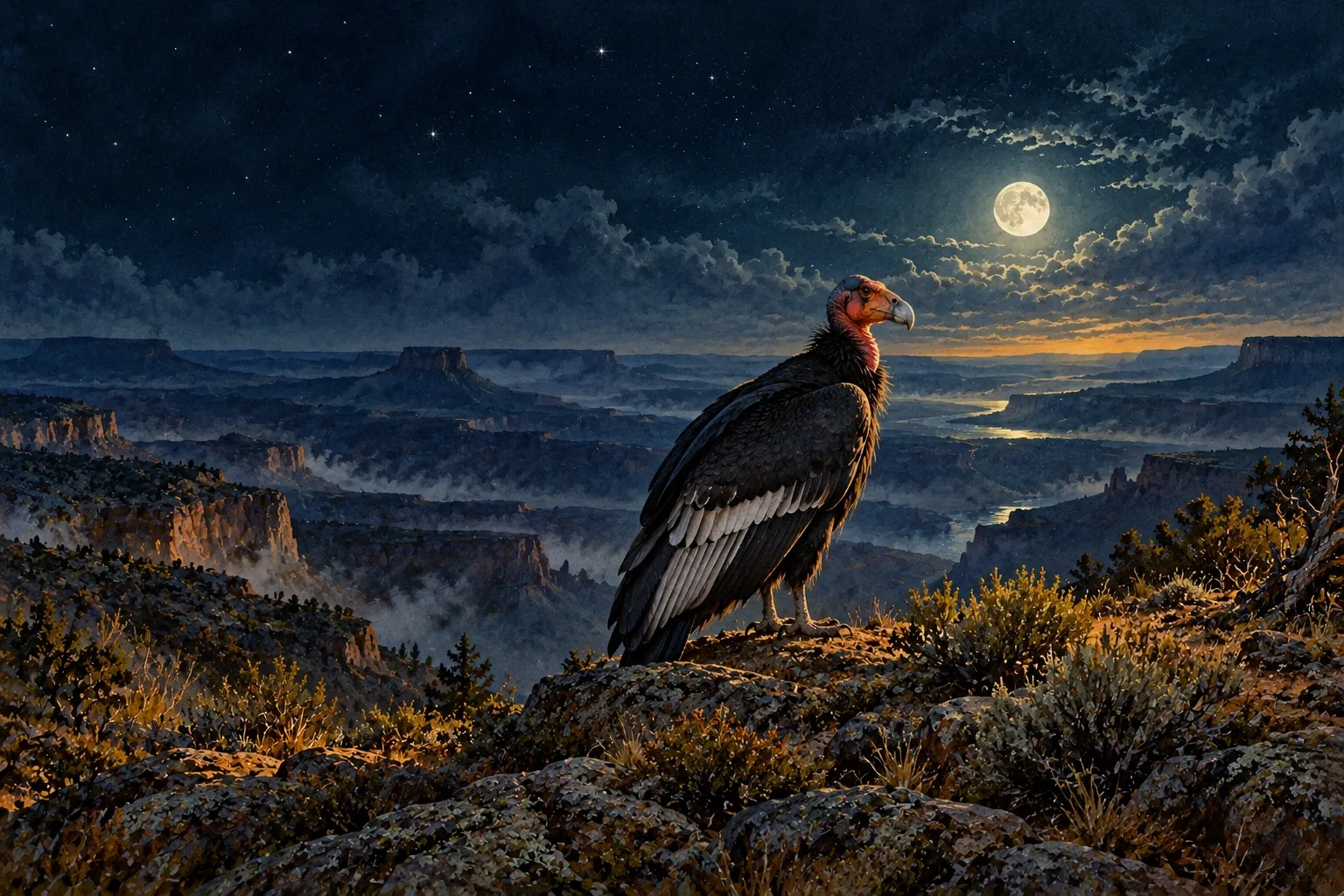
A condor can cross a mountain sky without a hurried beat of its enormous wings. It catches the rising air and lets the wind carry its weight, while its sharp eyes keep watch over the ground. Below, it finds what has been left behind and turns death’s remains back into part of the living world. The condor’s meaning begins there: rise high enough to see clearly, then meet what is real with patience and make something useful of it.
The condor’s wide view
The condor is a scavenger, not a hunter. It searches for carrion and does the necessary work of clearing what has died. There is no fuss in this task, no demand that the past be made different. The bird takes what is present and, by feeding, helps return it to the cycle of life. Its spiritual meaning rests in that clear-eyed service: an ending can become nourishment, and what looks spent may still have a place in the world.
The condor also knows how to make height practical. It rides strong currents, sometimes gliding for long stretches, and stays aware of the earth below while it moves through the sky. That balance gives its flight a kind of wisdom. From above, you can see a wider pattern; from the ground, you can tell what the pattern asks of you. When confusion gathers, the condor teaches you to rise far enough to take in the whole landscape, then choose your next step with care.
Its great wings need the wind. The condor does not command the current; it reads and uses it. This is a bird of freedom, but its freedom has attentiveness in it. Change is already moving around you. Watch where the air lifts, where it turns, and where it falls quiet. The condor’s way is to spend effort wisely and let the conditions carry part of the weight.
What the condor lends in a hard season
When the condor comes into your life for a season, its work is to help you face a loss or a difficult change with a steadier gaze. The bird feeds where life has ended, then lifts back into open air. It asks you to look for what can be learned or put to use, even when the gift in an experience is not visible yet. Take time before you decide what the ending means. The condor waits for the right current, and you can wait until the next step comes into view.
A lifelong kinship with the condor carries the same patience into changing times. The bird lives in windy places and understands that a current can shift beneath its wings. Its nature speaks to people who watch carefully, keep their energy for what matters, and can guide others through a transition without pretending the path is simple. It does not need to beat its wings at every gust. It knows when to lean into the air and when to let the air do the work.
Call on the condor when a task asks for perspective, composure, or the willingness to deal with what others leave untouched. It scavenges; it does not chase prey. That difference teaches a practical strength: notice the opportunity already present, and act when the time is right. If you are in a mess, begin with the plain work of sorting and clearing. If the circumstances cannot be changed, first see them as they are. The condor’s broad view helps you find the useful opening inside a hard situation.
The condor also shows devotion through the life it shares with a mate. Both parents incubate and feed their young. Its strength is not only solitary flight; it includes the steady care of a shared responsibility. Bring that kind of fidelity to a commitment that matters. Keep showing up for the work of tending it.
Condor dreams and their turning points
A condor flying away from you in a dream points toward an argument or loss coming to an end. The bird is receding from view, and the strain may be easing with it. Let the image be one of distance opening between you and what has worn you down.
A dream crowded with condors can suggest malicious gossip. The many birds gather attention around what is being said about you. The image asks for clear sight: distinguish the noise from what you know to be true, and do not let rumor set your course.
If you hear a condor’s call, an old secret may be close to coming into the open. The call carries across distance; something hidden is finding its way into hearing. A condor circling overhead, by contrast, marks an ending that can begin a new cycle. The bird circles before it settles on what it has found. Give a change its full shape, and watch what becomes possible as one phase closes.
The condor in Andean and Wiyot traditions
The Wiyot of California regard the condor as an ancestor. In that tradition, the bird’s presence carries kinship across the boundary between human and animal life. The condor is more than a sign of lofty flight: it belongs to a people’s story of where they come from.
Among the Mapuche of Chile and Argentina, the condor is called the king of birds. Andean people who lived at Machu Picchu connected the condor with fertility and believed its wingbeats gathered clouds that brought rain to nourish the land. These traditions give the bird a place in the life of a community and its landscape: authority in the sky, and a link between wind, rain, and fertile ground.
The condor’s teaching returns to its slow passage over the mountains. It sees the whole slope, waits for a rising current, and carries what has ended back into the living cycle. Let its dark wings tilt into the wind; let your own gaze grow wide enough to find the next useful thing.