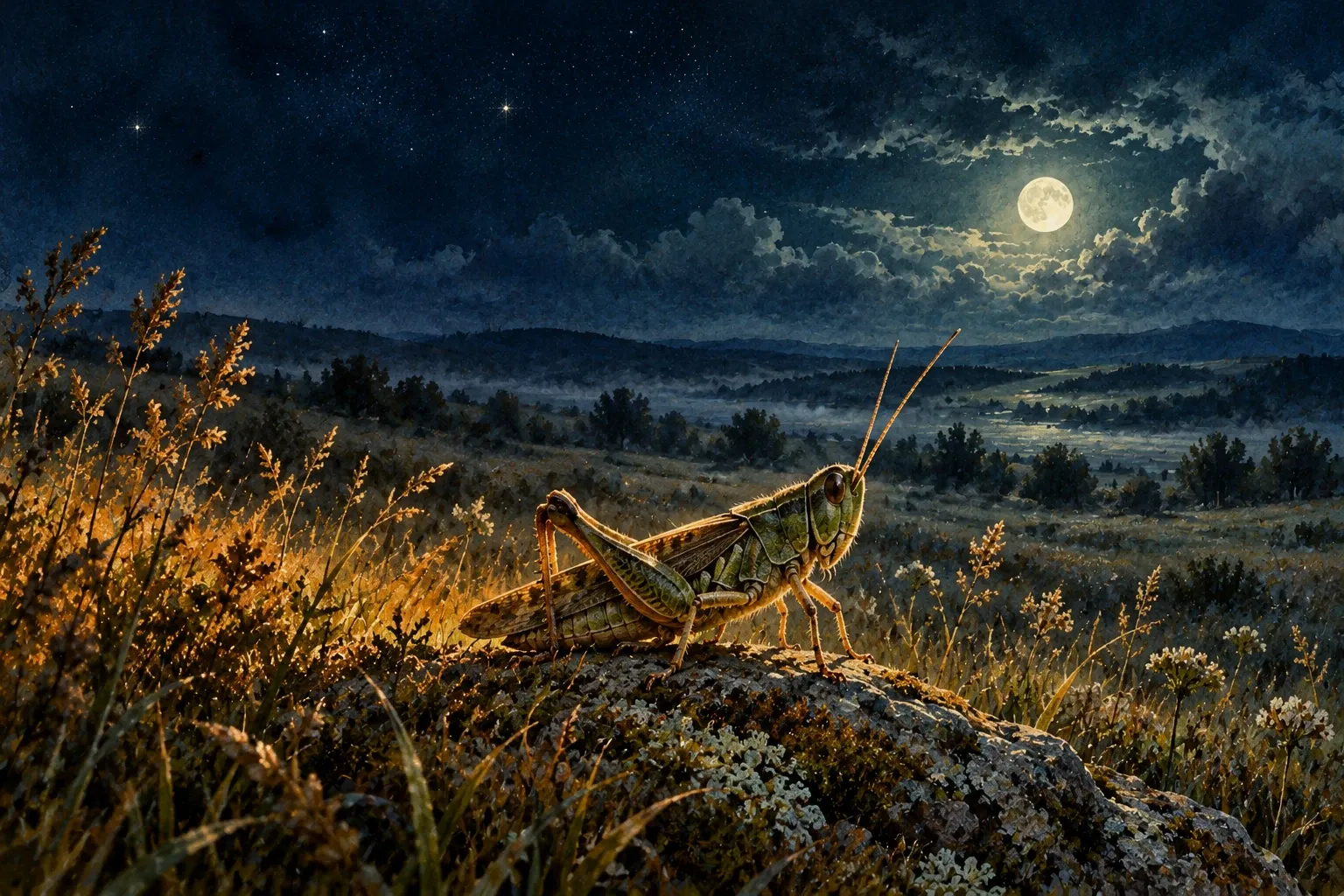
A grasshopper settles on the warm side of a mound, still as a fleck of green against the earth. Then its long hind legs fold and release, and it vanishes in a leap that can carry it many times its own length. It does not cross the field one careful step at a time. Its meaning begins there: trust the moment when you are ready, and let a single brave movement take you farther than slow effort could.
When the grasshopper’s stillness is gathering strength
The grasshopper knows both pause and sudden motion. It seeks the sunny side of a mound, taking in warmth before it jumps. Its stillness is part of its readiness. If your path seems quiet while other people move steadily ahead, remember the grasshopper on its bank: your pace may be gathering strength for a leap. Listen for the inner signal that tells you when to go, and let your own rhythm lead.
The grasshopper’s hind legs are made for a different measure of progress. A leap can clear ground that would take many small steps to cross. Its gift is not a promise that every risk will succeed; it is the nerve to begin when the next step is visible, even if the whole route is not. When a season has gone stale, the grasshopper asks you to move. When you are choosing a difficult task, call on the strength to act with your whole body, as it does when it springs from the earth.
A grasshopper’s body also listens. Its hearing organs sit on its front legs, and turning those legs helps it locate a sound. Let that image sharpen your attention: notice what you have been hearing beneath the louder voices around you. The grasshopper carries a particular nature, too. Some males rub a hind leg against a forewing to make their song. Its song belongs to its own kind and its own moment. Keep the voice that is yours; do not borrow someone else’s tune to make your way.
Its song, its kinship, its power
Grasshopper nature is alert, warm-seeking, and ready to change course in a single burst. It can feed on plants and, in great numbers, gather into swarms that travel together. This small insect carries two truths at once: individual readiness and collective force. Follow its example when your own nature calls for a bold move, and remember that your choices land in a shared field. A leap toward abundance can also consume what others need.
In China, people have associated grasshoppers and crickets with good cheer, luck, abundance, and virtue. Some believed that a departed relative could return in the form of one of these insects, and made small cages for those they found. In the ancient Greek world, the grasshopper stood for nobility. Ancient Hebrews, by contrast, used it as a symbol of the scourge. Each meaning follows a different encounter with the insect: its bright presence, its dignity, or the damage a multitude can bring.
The Aztecs named the place now called Mexico City Grasshopper Hill, recalling the mating grasshoppers there. Rain and water reservoirs deepened the insect’s association with fertility and life. People ate grasshoppers for prosperity and offered them at temples in Tenochtitlan. But swarms could also devour crops, so the grasshopper carried the threat of destruction alongside the promise of plenty. Among the Hopi, parents have teased misbehaving children with the warning that Grasshopper will bite off their noses. These are distinct stories, shaped by the places and people who tell them; the grasshopper does not speak for every tradition.
What a grasshopper does in a dream
A grasshopper that springs forward in a dream may point toward a bold move or a new experience. Its leap offers a glimpse of what lies beyond the familiar patch of ground. You may not see the entire path from where you stand, but the image suggests that movement itself can reveal more of the world.
If the grasshopper hops backward, sideways, or in a confused flurry, the dream may echo a period of scattered attention or indecision. The insect is moving, yet its motion seems to lead nowhere. Consider what is pulling you in several directions and where you can set your attention for a while.
A grasshopper feeding in healthy green grass brings an image of sustenance and favorable conditions. If the grass is dead or dying, the dream may carry concern about what nourishes you, materially or inwardly. The grasshopper depends on what grows around it; the dream’s landscape matters as much as the insect.
The leap that carries its own light
The grasshopper waits in the sun, listening with its legs, and then the field opens beneath a sudden spring. It teaches that progress has its own rhythm: preparation can look like stillness, and one well-timed leap can change the view. When you picture it poised on the mound, remember the warmth it gathered before it moved—and the living ground it leaves behind.