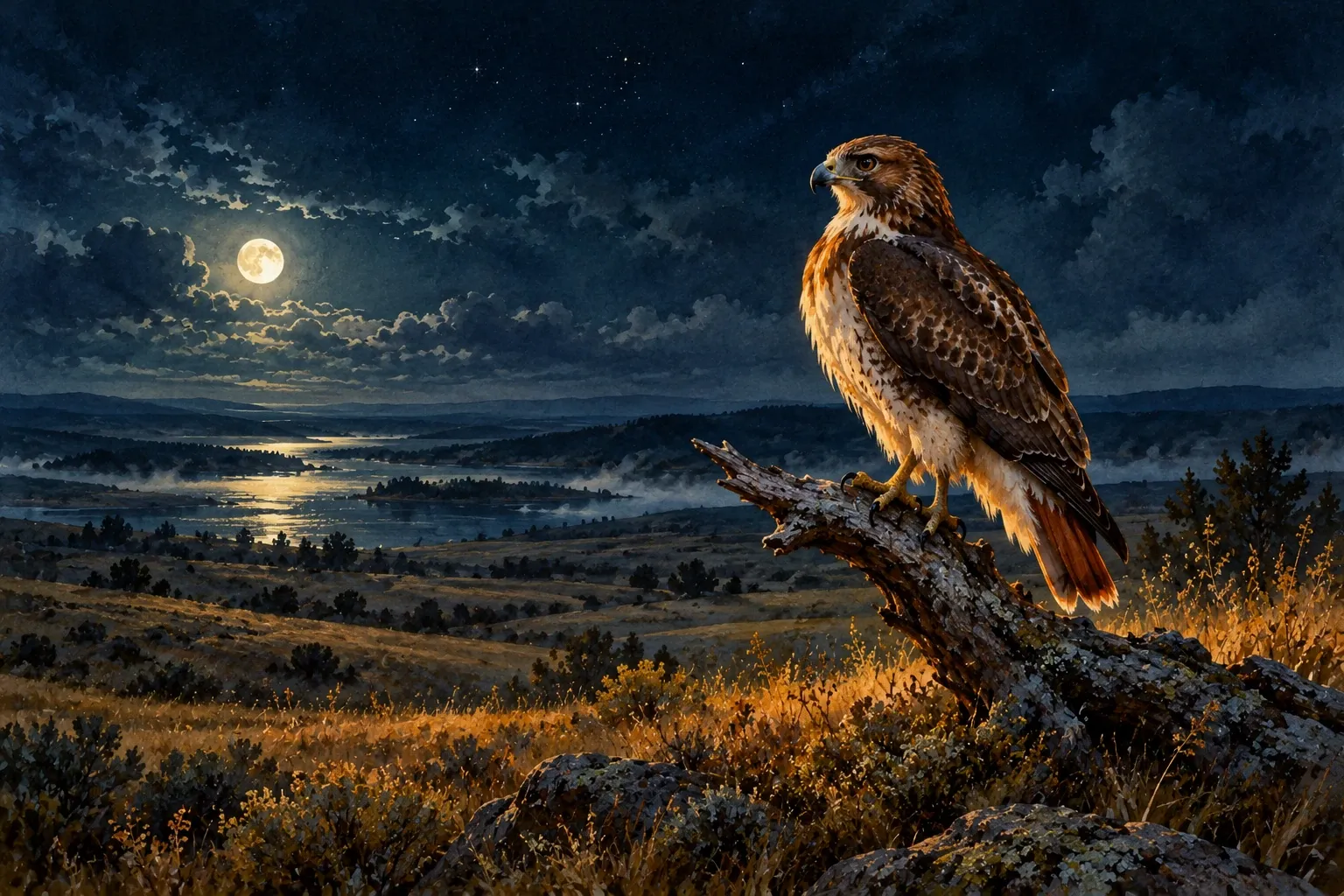
A red-tailed hawk can sit on a fence post for a long while, its head turning as it studies the field. Then it drops, fast and certain, toward a mouse hidden in the grass. That is the heart of Hawk’s teaching: rise high enough to see what matters, then bring your attention down to the one thing that needs doing. Hawk joins clear vision to action.
Hawk sees the whole field
Hawk’s eyes catch small movement across a wide stretch of ground. From above, the bird watches, circles on the air, and waits for the right moment. Its way of hunting carries a plain lesson: don’t let the nearest detail fill your whole view. Step back. Look again. When the choice becomes clear, act with care and speed.
Hawk brings this message when a season of life has narrowed around one worry or decision. It asks you to lift your attention, notice what has been missed, and listen for the message hidden in ordinary events. Then it asks you to focus. A hawk does not dive at every stir in the grass. Its strength lies in choosing its moment.
There is room in Hawk’s vision for both distance and detail. The bird can ride the currents above the land, then spot a small animal below. Keep the broad view, but don’t lose sight of what is close at hand. A clear plan still needs its next step.
A lifelong eye for the horizon
For someone whose kinship is with Hawk, this wide, watchful sight is a familiar part of life. You may be the one who sees a pattern forming while others are caught in the particulars. People come to you for perspective, and your words can help them find a way forward. Hawk’s steady partnership also carries a teaching about loyalty: many hawks mate for life, and both parents help protect and raise their young.
That keen sight asks for tenderness as well as truth. A hawk can see what another creature would rather keep hidden, but vision alone does not decide how to use what is seen. Speak clearly, without making every truth a weapon. Stand beside those who trust you. When smaller birds harass a hawk in flight, it keeps to its course; people who misunderstand your gifts need not choose your direction for you.
Hawk’s soaring flight depends on currents it does not command. It knows when to ride the air and when to move under its own power. Let that be a guide when plans change: watch what is happening, adapt to the conditions, and keep your attention on the larger purpose.
When the work calls for focus
Call on Hawk’s strength when a task demands patience, vigilance, and a clear finish. A hawk watches before it strikes; it does not spend its strength in restless motion. Let that discipline help you study the situation, set aside distractions, and choose the useful move. When something important is easy to miss, Hawk reminds you to look closely. When fear or anger has clouded your judgment, rise above the first rush of feeling and see the whole field again.
Hawk’s dive is not a call to force every outcome. The bird waits until the opening is real. Prepare, decide, and follow through when the time comes. Its strength is in the joining of alertness and commitment.
The hawk in different traditions
Ancient Egyptians linked the hawk with the divine and the journey of the soul. Horus, the sky god, was sacred to the hawk; Egyptian images also gave the bird a place in ideas of spirit and rebirth. Isis takes hawk form to save Osiris. These stories give Hawk’s high flight the weight of passage between worlds and sight beyond the ordinary.
The Pueblo used the red-tailed hawk’s feathers and energies in ceremonies for healing and for bringing rain and life-giving water. Ojibwa teachings connect the red-tailed hawk with leadership, deliberation, and foresight. These meanings grow from a bird that watches carefully before moving, and from its cry, which carries across open country.
Celtic traditions cast Hawk as a messenger from the ancestral world, a bird whose appearance calls for sharp wits and attention. In Japan, Hawk carries nobility and good fortune, linked to its ability to seize prey and carry it away. Each tradition gives the bird its own place: guide, messenger, or fortunate hunter.
When Hawk enters a dream
A hawk flying through a dream can point toward a choice that needs a cooler head. Its sight brings the question of what you can see from a greater height, and whether action is called for. If it climbs high into the sky, the dream may turn your attention toward spiritual growth. If it swoops downward, it may bring your thoughts back to practical matters close at hand.
A hawk watching or staring in a dream can suggest that something in your surroundings needs closer attention. Notice what the bird watches; that may show where your own attention belongs. A hawk chasing you, in an Arabic dream tradition, may signal that a powerful person is displeased with you. Let the dream’s particular scene set its meaning; the same bird can carry a warning, a call to prepare, or a reminder to distinguish one path from another.
Hawk’s lesson returns to the field: look widely, wait until you see what matters, and then choose your course. Above the grass, the red tail catches the light. The bird circles once, finds its mark, and folds its wings.