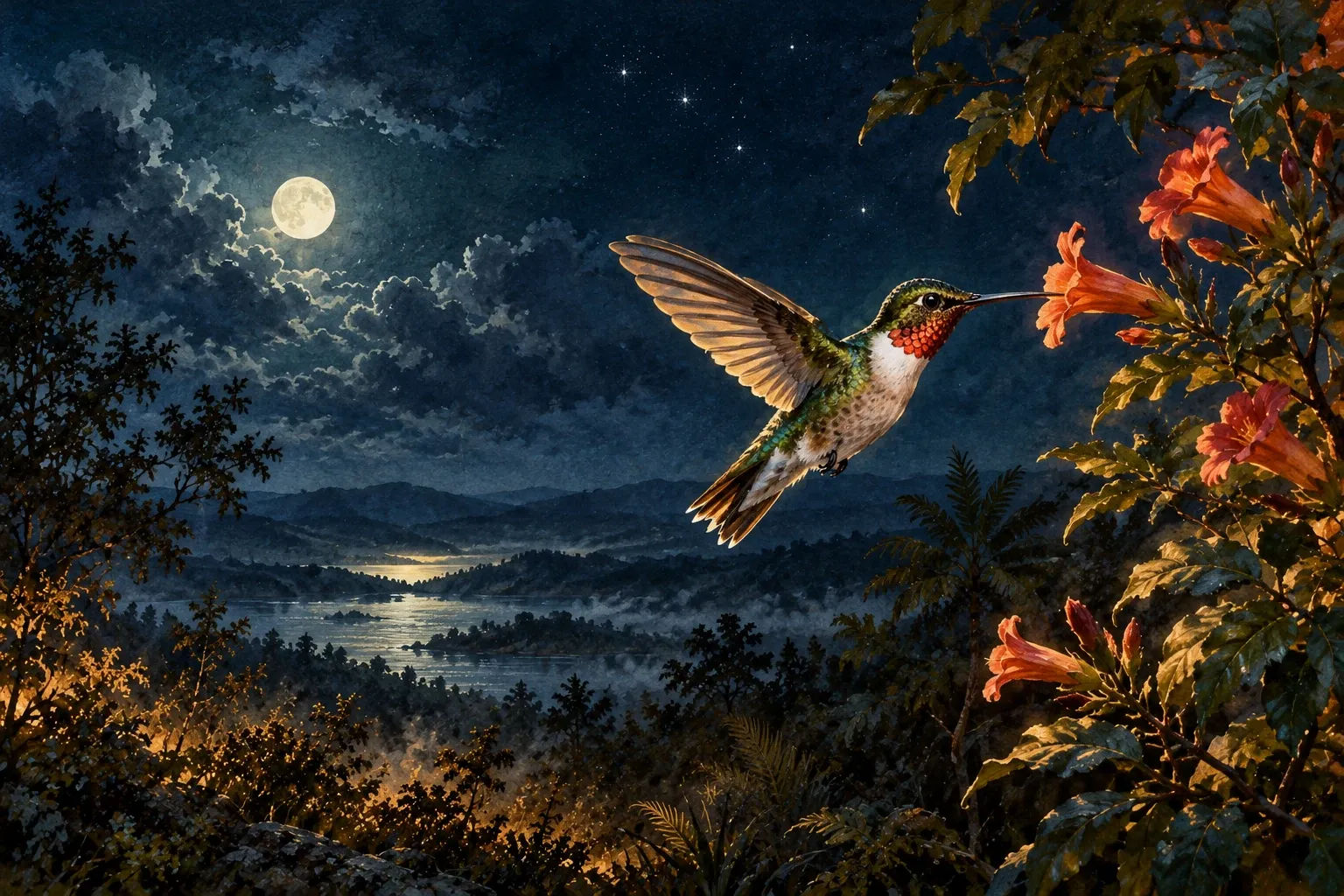
A hummingbird holds still before a flower while its wings blur, drinks for a moment, then darts backward as if the breeze has changed its mind. Its life is quick, but its attention is exact: it remembers the blooms it has visited and returns when their nectar is ready. Here is its teaching: seek the sweetness that sustains you, and remember what gives you strength.
The bird’s jewel-bright feathers catch a different color with every turn. Its small body carries astonishing energy, yet even this tireless flyer must feed often and rest when night falls. Hummingbird teaches joy with clear eyes: take delight in what is here, learn where your nourishment comes from, and keep enough strength for the long flight ahead.
The sweetness hummingbird knows
A hummingbird’s long bill and tongue reach into flowers for nectar. As it feeds, pollen catches on its head and bill and travels with it to other blossoms. Its life is bound up with the flowers it visits. That close exchange gives its sweetness a practical meaning: joy is part of what keeps life moving, shared between the bird and the bloom.
When hummingbird appears as a spirit animal in a season of heaviness, it reminds you to notice the small pleasures still within reach: a bright color, a welcoming voice, the scent of a flower near the door. Its wings beat too quickly to follow, but its hovering asks for a pause. Let your attention settle long enough to taste what is good. If your heart has drawn inward, hummingbird’s visit speaks of opening again to affection and delight. It carries a message of hope in motion: you can turn toward what nourishes you, even after a difficult stretch.
A lifelong kinship with hummingbird belongs to someone who can adjust quickly and find brightness in changing circumstances. The bird moves forward, backward, up, down, and sideways; it does not require a straight path. It also remembers where it has fed and how long a flower takes to replenish. Its example joins flexibility to discernment: know what nourishes you, and give your energy where it can return as life.
Hummingbird people notice what others overlook. A small kindness, a fresh idea, a patch of color at the edge of a busy day can restore their spirits. Their sensitivity helps them sense when a room has grown harsh or when someone needs a little warmth. The bird’s lesson includes a boundary, too. A hummingbird defends its feeding ground with startling boldness, and a person who carries its kinship can learn to leave places that drain the heart. Lightness is not fragility. It is the skill of staying responsive without surrendering your freedom.
When a task calls for quickness, courage, or a fresh start, call on hummingbird’s power. The bird can stop in midair and change direction in an instant; it can meet a much larger intruder at its flower patch. Its speed is useful because it comes with precise attention. Move with purpose. Turn when the way changes. Rest before your strength runs dry. Hummingbird’s bright energy is not endless; it is carefully gathered and spent.
Hummingbird in dreams
A hummingbird in flight can point to an idea gaining speed or a stretch of life that calls for nimble changes. If it pauses in midair, the image may mark a still point before a new direction becomes clear. Backward flight brings the past into view: there may be something there worth carrying forward, a lesson or a source of sweetness you had forgotten. Darting, shifting flight can echo a time when thoughts are changing too quickly to settle.
A hummingbird hovering near a flower brings attention to nearby sources of energy and pleasure. What the bird approaches matters: the flower can stand for a friendship, a project, or a simple delight that gives life its sweetness. A graceful, steady flight may accompany an easier transition in a relationship or a changing season. A figure eight traced in the air may suggest a link between what has been and what lies ahead, or a renewed connection with your spiritual path. Let the dream’s particular movement carry its meaning: where the bird turns, what it returns to, and whether it finds the flower.
Stories held in the hummingbird’s wings
The deity Huitzilopochtli’s name has been translated as “Hummingbird-Left,” “Hummingbird-South,” or “Hummingbird-Sinister.” The hummingbird held an honored place in Nahua thought and was associated with warriors who died in combat. In that tradition, the bird’s tiny body holds an image of courage and return; its quick flight belongs to a story of life continuing beyond the battlefield.
Pueblo traditions connect hummingbirds with rain and the renewal it brings to dry land. Some Pueblo communities have used the bird’s image in ceremonies and painted it on water jars, joining its rainbow colors and hovering flight with the hope of life-giving water. The hummingbird carries offerings and prayers in some Pueblo ceremonies. These are particular traditions, rooted in distinct communities and places, and the meanings live within those traditions.
In a Mojave story, people living beneath the earth in darkness send the hummingbird to search for light. The little bird finds a path to the world above and the sun. Its smallness does not limit the journey: it becomes the guide who discovers a way out. The story’s hummingbird does what the bird does among the flowers, too—finds an opening, reaches toward what sustains life, and leads the way.
Keep the nectar for the journey
Hummingbird’s joy is lively, but never careless. A bird that feeds at many flowers must remember their locations; one that migrates must gather energy for the distance; one that hovers must keep its wings moving even when the world seems still. Its brightness comes with attention and effort. Receive the sweetness that is here, protect the places that sustain you, and save your strength for the journey. Somewhere above a flower, the hummingbird hangs in the air, its jeweled throat turning toward the sun, then vanishes into the light.