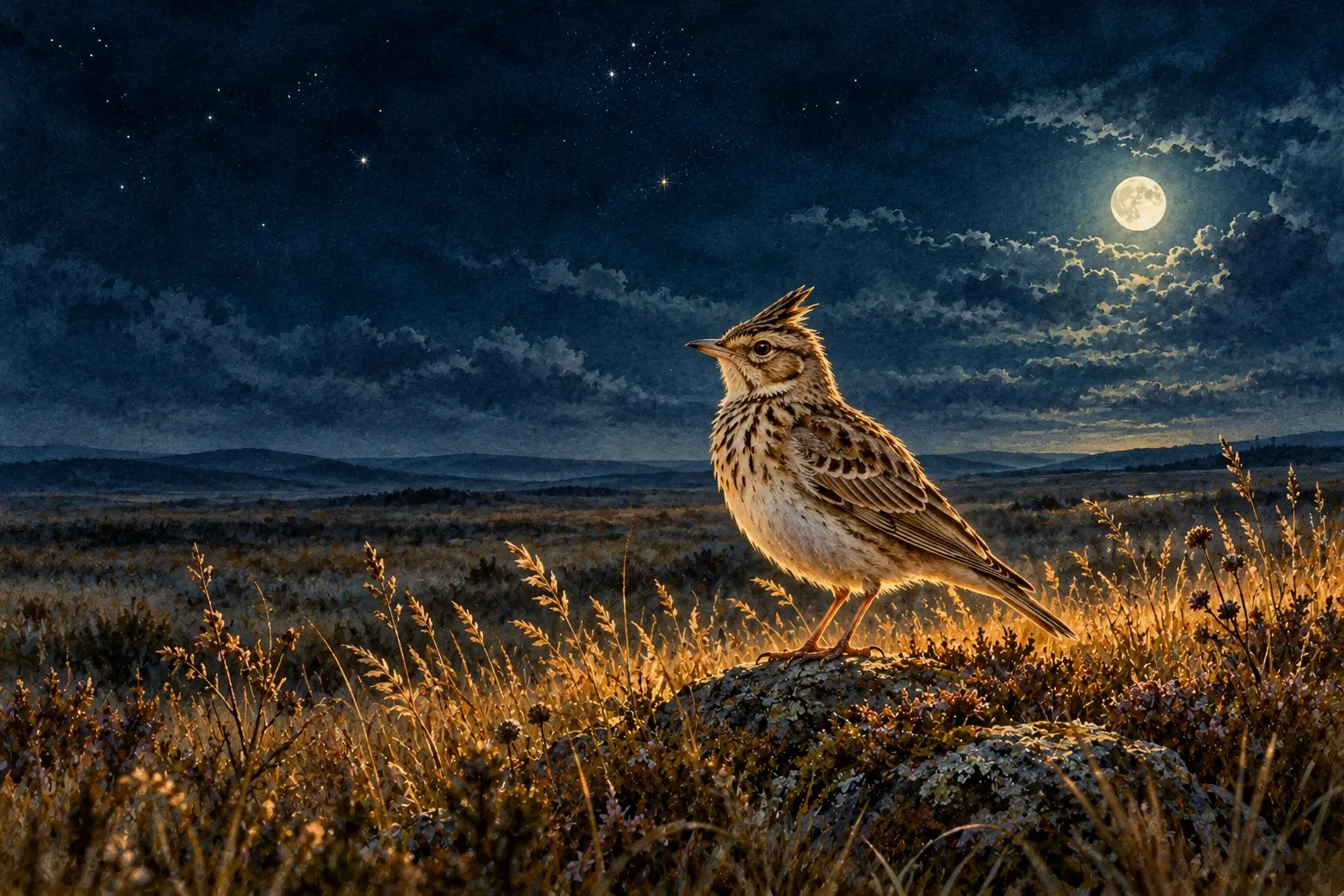
A lark can pour out its song while rising high above the ground, then fold its wings and drop back toward the earth. That bright voice belongs to a bird that spends much of its life close to the soil, where brown feathers hide it among grass and seeds. The lark’s meaning lives in that passage between ground and sky: keep your feet in the life you have, and let your voice carry what is true and joyful.
The lark’s song carries its meaning
Most birds sing from a perch. The lark sings in flight, giving its melody to the air while it climbs. Its song makes joy an act of expression, something offered as the bird moves through the world. When discouragement settles over you, the lark’s example is plain: use your voice. Sing while you work, tell the story you have been holding, or speak the truth that needs saying.
A lark’s voice can be heard even while the bird is out of sight. Its brown coloring helps it blend into the ground, but the song gives it presence. This is a bird whose expression reaches farther than its appearance. Let that remind you to value what you communicate, not only what people can see. Words spoken with care can steady a room; words used harshly can leave a mark. The lark asks you to know the weight of your own voice.
The lark also listens. Its ability to imitate other birds and even voices gives its song a quality of attention: it takes in sounds and carries them onward. Call on that listening when another person’s story needs to be heard before you answer. A message grows wiser when it has made room for what others have said.
Finding your way between earth and sky
The lark’s flight has two movements: an ascent toward the heavens and a quick return toward the ground. In this spiritual picture, the bird is a messenger between spirit and embodied life. Its flight gives a shape to perspective: rise far enough to see the whole of a situation, then return with what you have learned and put it to use in ordinary days.
The lark’s life begins close to the earth. There, its muted feathers help it forage among grasses and seeds, and there it guards its nest with vigor. It is both a bird of high flight and a careful protector of what is near. That balance speaks to purpose: let your vision grow, while keeping faith with your daily work, your promises, and the people in your care.
When a hard season has left you dispirited, the lark lends its upward energy through the very act it is known for: it keeps singing as it flies. Let your own voice find a small, steady note of hope. When you have a task that depends on communication, the lark’s power is in its song: gather what you have heard, then speak so your message can travel. If the lark feels like a lifelong kinship, its nature is joyful and expressive, yet still rooted in the ground where it feeds and protects its nest.
The lark’s song is not a promise that every worry will disappear. It is a reminder to bring your attention back to the present voice and the work in front of you. Keep your word. Speak with care. Let enthusiasm for your talents become something useful to others.
The lark in cultural stories
The Lakota tell of the lark as a messenger from Itokaga, the god of the south wind. The south is linked with the sun, warmth, and light that sustain life. The story connects the lark’s presence with fertility and a joyful bond with a loyal partner. It also places the south in summer, a season of rapid growth and heat. These meanings belong to that specific story and its associations; they are not a teaching to assign to every people.
The ancient Celts of the British Isles regarded the lark as sacred. No particular Celtic story is given here, so the lark’s sacred standing is the extent of what can be carried forward here.
Hear the song, then return to earth
The lark climbs into the open air with its music and comes back down to the grasses where it feeds and guards its nest. Its teaching is to let joy and truth rise in your voice, then bring them home to the life you are responsible for. The song fades, the bird settles among the earth’s quiet colors, and still you remember how it sounded above you.