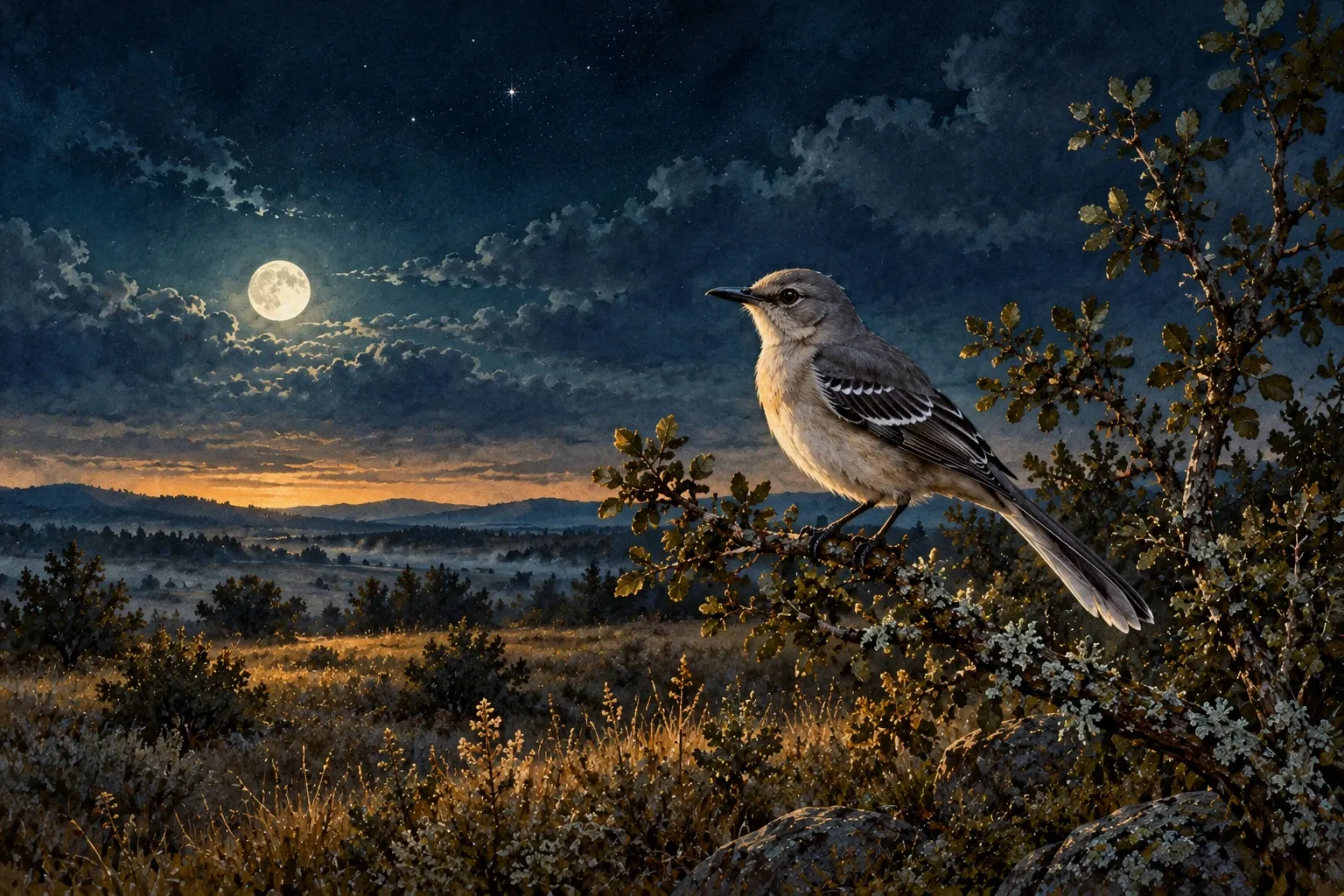
A mockingbird can sing another bird’s call, then answer with a sound borrowed from a cat or a barking dog. From a hedge or rooftop, the gray singer gathers these voices and sends them out again, sometimes carrying its song into the night. Yet it does not disappear into its imitations. It listens, learns, and makes a living song of what it has heard. Mockingbird teaches us to pay attention, use what we learn, and let our own voice ring clear.
The song you make from what you hear
Mockingbird learns by listening. It takes in the calls around it, practices them, and gives them back with a skill that can make a yard seem full of different voices. Let its example guide you through a season when you are finding your words or bringing a quiet talent into the open: listen closely, practice what you admire, and let the learning become part of your own expression. A voice grows through use; a gift kept hidden cannot find its tune.
The bird’s many calls also show how much can be carried by sound. Mockingbirds can imitate birds and other animals, and they read a place with a sharp, attentive eye. When you speak with someone, listen for more than the words: watch the pause, the turned shoulder, the welcome in a face. Mockingbird’s gift is to hear the small signals and answer with care. Its music is playful, too; surprise and delight belong in a voice that has learned to be brave.
Those who feel a lifelong kinship with Mockingbird carry a nature that is observant, adaptable, and expressive. This is a bird that lives near people and fills the air with song, yet keeps watch over its surroundings. Share your gifts and learn from those around you; choose carefully which voices you let close to your nest. Mockingbird shows that curiosity and discernment can sing together.
A small bird with a fierce heart
A mockingbird may look modest, but when its nest is threatened it drives away intruders much larger than itself. It will face cats and other raiders to protect its young. Its courage comes from knowing what it is guarding. When a difficult task asks you to speak up or defend someone in your care, call on that fierce little guardian: name the boundary, stand your ground, and keep your attention on what matters.
Mockingbird’s song is also a lesson in persistence. It gathers sounds through patient listening and practice; its abilities are made through attention. If a talent or purpose has been waiting in the background, bring it forward one small effort at a time. Learn from someone whose skill you respect, then make the work your own. The bird’s voice is rich because it has taken in so much and kept singing.
When Mockingbird enters a dream
A singing mockingbird can point toward a good outcome when you trust your judgment and let your particular song be heard. The dream may come when you are ready to share a talent you have kept private. Hear the bird’s melody as a reminder that confidence grows as you use your voice.
If the bird flies angrily toward you, its fierce defense of home turns the dream toward your own conduct. You may have crossed a boundary or spoken with more pride than care. Let the image bring you back to respect and proportion.
A quiet mockingbird can stand for a settled sense of self, one that does not need a crowd’s approval. A nest built in someone else’s yard or building may point to taking credit for work that belongs to another. And a bird calling from behind leaves can echo uncertainty about the signals you are getting in a social situation. The bird’s action and setting shape the dream: the same singer can reassure, warn, or ask you to give credit where it is due.
Stories of speech, guardianship, and peace
Hopi and Pueblo traditions place Mockingbird in the creation of human life, teaching people to speak. In these stories, the bird’s many voices become a gift that helps people find words of their own. Shasta tradition gives Mockingbird another role: guardian of the dead. The Maricopa of Arizona welcome the bird in dreams as a sign of special powers. Pima stories cast Mockingbird as a mediator and peacemaker. Each tradition holds its own meaning, shaped by the people who tell it.
In a Mayan tale, a young Mockingbird learns songs by quietly listening to a teacher’s lessons for a Cardinal. When the Cardinal’s daughter cannot perform, Mockingbird sings from inside a tree while the daughter pretends the song is hers. The father discovers the bird and asks her to sing for everyone. Her voice wins the gathering, and her descendants are given beautiful songs. The tale remembers what patient listening and practice can make of a talent, even when no one first thinks to notice it.
In Texas, lawmakers named Mockingbird the state bird in 1927. Its familiar song and spirited defense of its home make this small singer a fitting emblem.
The mockingbird’s song never stays borrowed for long. It rises from the hedge with a dozen voices inside it, then opens into one clear call of its own. Listen well, learn freely, protect what you love, and when your moment comes, let your own song carry across the yard.