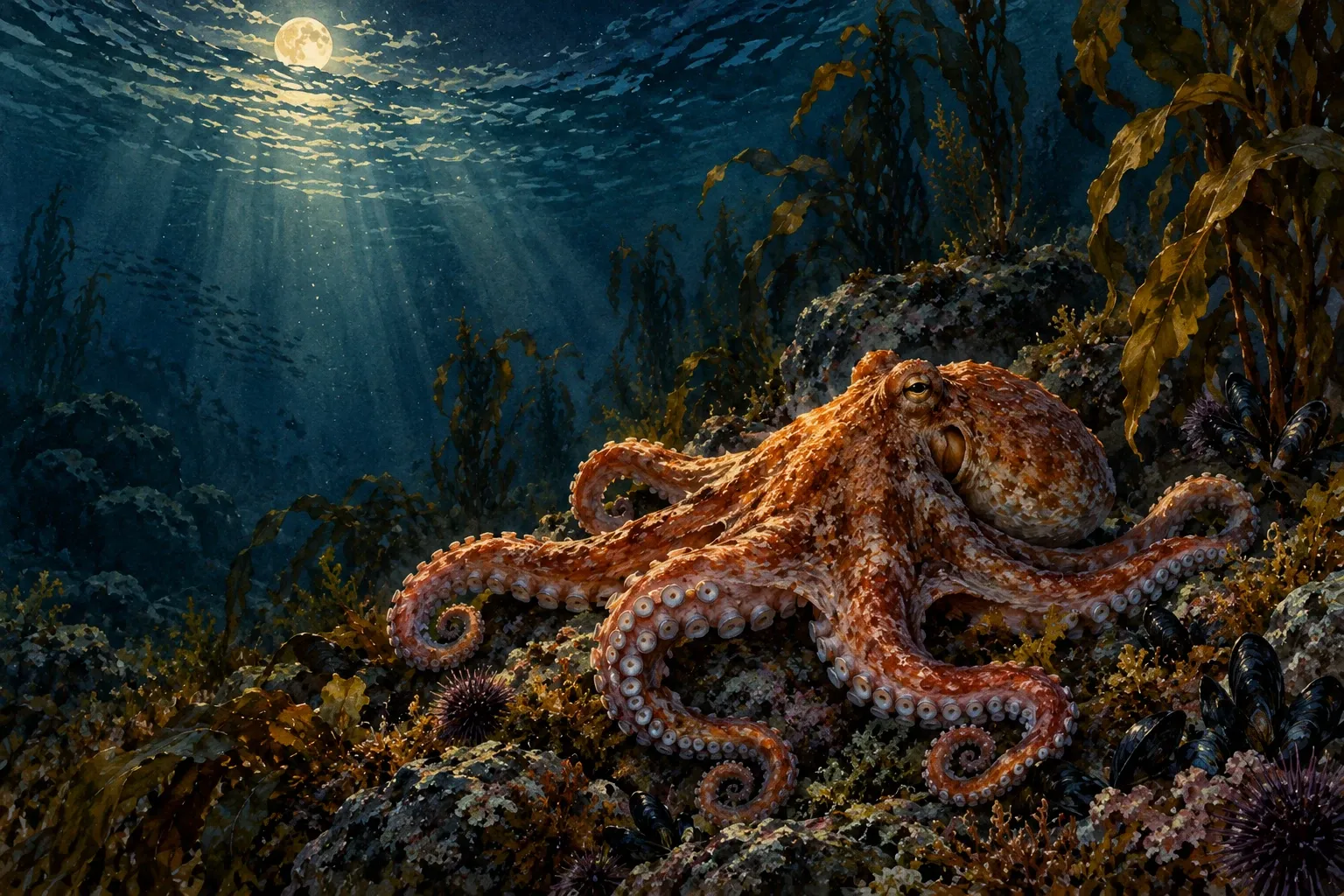
An octopus can pour its soft body through a crack that looks too small to admit it. If danger follows, it changes color, folds itself against the reef, or sends a dark cloud of ink between itself and its pursuer. It survives by reading what is around it and changing its course. That is the octopus’s old spiritual teaching: intelligence can bend, hide, and begin again.
Its eight arms seem to reach in every direction, yet the animal keeps close to the shelter of rocks and crevices. It knows when to explore and when to hold a safe place. The octopus brings cleverness, discernment, and the courage to release what has become a trap.
The wisdom of changing shape
An octopus has no rigid skeleton to keep it in one form. Its pliant body passes through narrow openings, and its skin shifts color and pattern in a blink. When octopus comes into your life during a tangled season, it teaches you to study the opening before you push against the wall. A problem may have a side door. A plan that once fit may need a new shape.
The octopus also knows the worth of shelter. It makes its home among rocks and reefs, close to a place where it can retreat and watch. It can stay hidden, then venture out when the way is clear. Its message is to choose your moment. When the water turns rough, step back long enough to see what is happening. Gather the facts, keep your purpose close, and move with care.
There is a deeper strength in this animal’s readiness to let go. An octopus can leave an arm behind to escape and later grow another. Loss is real, but it does not have to be the end of your reach. When a part of life cannot be carried forward, the octopus teaches you to free yourself and put your remaining strength toward what is still possible. Its renewal is not a denial of what was lost; it is a way of continuing after loss.
The animal’s cleverness is practical. It hunts among the reef, works its way into tight places, and uses camouflage and ink to avoid danger. It does not spend strength on a contest it can escape. When a task calls for discretion, the octopus lends its quiet skill: observe, wait, and act with precision. Call on that nature when you need to solve a knotty problem, protect your privacy, or find a fresh route through a crowded day. Cleverness is strongest when it serves a clear purpose.
For those who feel lifelong kinship with the octopus, its many arms suggest a mind that can reach toward several possibilities at once. Such a nature prizes ingenuity, learning, and the pleasure of solving a puzzle. But a creature with many ways to move still returns to its den. The octopus asks you to come back to a steady place, tend to the work in front of you, and remember the living things that depend on you.
When you need strength for a particular effort, borrow the octopus’s flexible body and alert eyes. It crawls along the bottom when swimming would cost too much, and it changes course when the current changes. Let that be your pattern in a demanding stretch: save effort where you can, adapt without losing your aim, and retreat from a danger that offers no useful path through it.
When the octopus visits your dreams
An octopus with its arms stretched in many directions may reflect a life pulled across too many demands. If each arm holds something, the dream may point to a wish to control what cannot be held. It is an image of divided attention and a tight grip. Loosen one hold and see which duty truly needs your care.
A moving octopus can mark a moment when a decision or opportunity calls for action. The image carries the animal forward through the water, away from endless circling. An octopus hidden on the ocean floor brings the dream back to shelter and patience; it may suggest that an idea needs grounding before you act on it.
Watch what happens when the animal meets a boundary. One slipping out of an enclosure or tight place may speak to freedom found through flexibility and a quiet exit. One leaving an arm behind carries a sharper image: withdraw from what is doing harm, even if leaving costs you something. The octopus does not need to win every encounter to survive it.
If the animal changes color, appearances around you may be shifting. If it releases ink, a direct confrontation may cloud the way forward; careful strategy serves better than a headlong charge. In each dream, the octopus’s action matters: hiding, moving, gripping, escaping, or releasing tells a different part of the story.
Octopus in island and temple stories
Hawaiian stories associate the octopus with Kanaloa, a god of the underworld. Another creation story remembers the octopus as the sole survivor after the cosmos was destroyed. The Hawaiian name He’e carries meanings of many-sidedness, mystery, and flexibility. In these stories, the animal’s ability to vanish into the sea and emerge elsewhere belongs to a world of deep change and beginnings.
Among the Ainu, Akkorokamui is a great octopus being and a powerful warrior. Its ability to regenerate limbs echoes the animal’s own renewal after injury. The image holds together danger and recovery: the octopus is formidable, yet what is lost can grow again.
A temple story tells of a monk whose ill mother longed for octopus meat. Bound by a vow not to kill living beings, he struggled with what to do, then bought an octopus for her. When he opened the box, the octopus had become eight sutra scrolls; the scrolls turned into a living octopus that leapt into the temple pond, and his mother recovered. Here the octopus carries compassion through a difficult choice and brings healing into the family’s story.
These traditions give the octopus different roles: survivor, warrior, divine companion, and bearer of sacred teaching. Each keeps its own place and meaning, while the animal’s changeable body makes a fitting figure for mystery, endurance, and renewal.
The octopus finds its way
After a long search, an octopus settles among the rocks, its skin taking on the colors of the sea floor. Its arms rest within reach, ready for another path through the reef. Keep that image when a difficulty closes around you: feel for the narrow opening, keep your wits near, and leave behind what you cannot carry. The octopus teaches that a flexible mind can find its way onward, then return to shelter beneath the moving water.