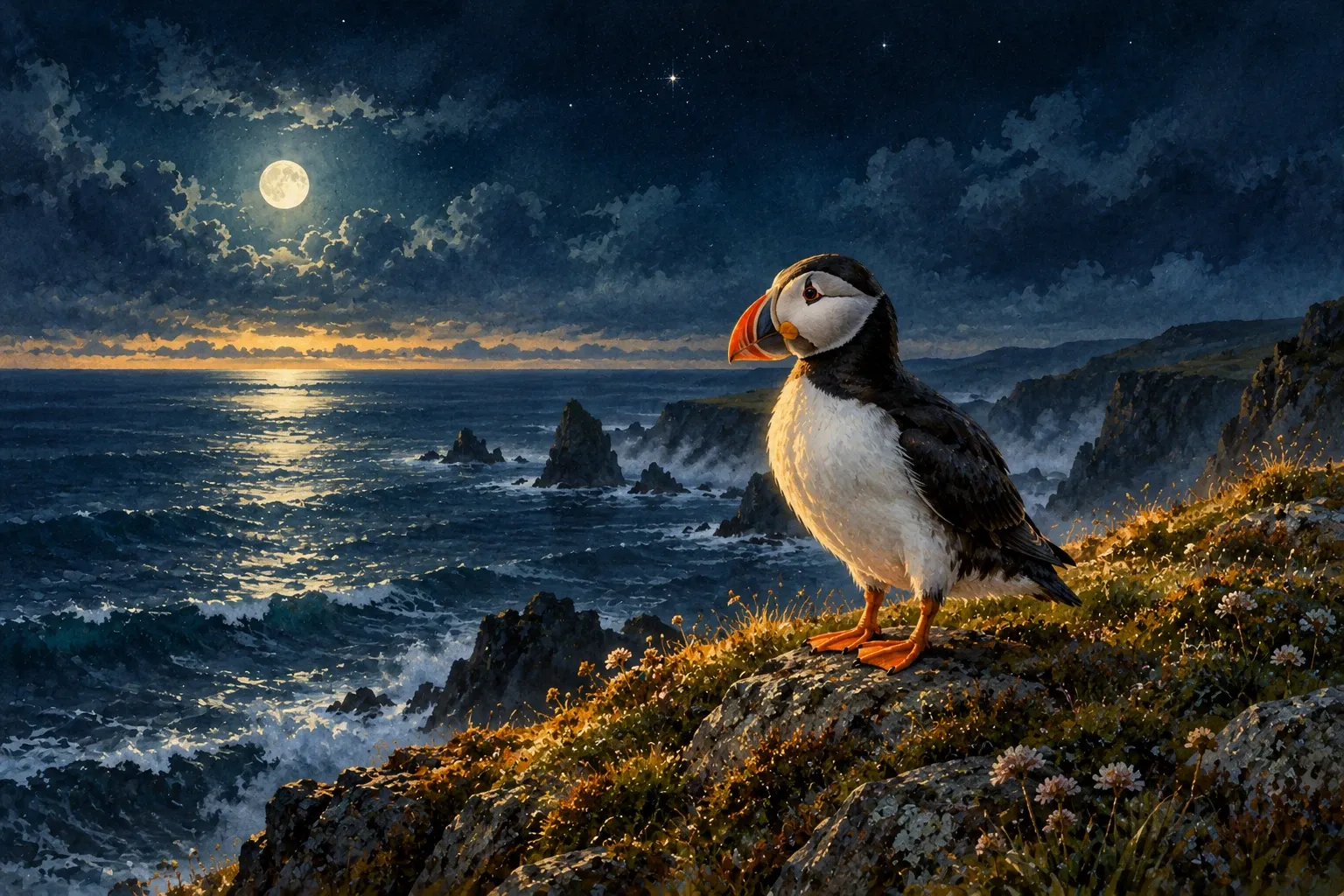
A puffin comes back from the cold sea with fish held crosswise in its bright bill, then slips into a burrow on the cliff where its mate waits beside their one egg. Its orange feet steer beneath the waves; its wings carry it between ocean and home. Puffin’s meaning lives in that double life: go far, dive deep, and keep faith with the place and the ones you love.
A bright beak, a faithful return
At the breeding ground, Puffin’s bill grows vivid orange. When the season passes, that bright color fades. The bird does not need to carry its summer finery all year to remain itself. It keeps its stark feathers, its quick wings, its sure return to the coast.
Puffin’s paired life has a steady rhythm. It meets its mate at the nesting ground, and the pair raises one chick together. Both parents take part in guarding and feeding the puffling. The nest is a burrow tucked among earth and rock, lined with grass, feathers, and seaweed. Here, loyalty is made of daily care: coming back, taking a turn, bringing food.
If Puffin is near in a season of change, let its return steady you. Keep tending the bond or home that asks for your care. A true commitment shows itself in the small acts repeated after the bright season has passed.
The courage to be your own kind of bird
On land, Puffin can look awkward, hurrying along with its head lowered through a crowded colony. In the water, those short wings become paddles, carrying it down after fish. In the air, the same wings beat swiftly over the sea. The bird’s gifts do not depend on looking graceful at every turn; they depend on knowing what each place asks of it.
Puffin’s bright bill and comical bearing make it easy to recognize. It carries its own oddness plainly. There is good humor in that, and a reminder that a life need not be solemn to be sincere. Puffin asks you to keep your particular nature visible, laugh at a stumble, and let play return when duty has grown heavy.
Its body speaks, too. A puffin moving quickly through a crowd keeps low; a parent standing guard grows upright and watchful. When challenged, it can puff itself up and plant a foot. Read the room as carefully as Puffin reads a crowded ledge. Let your posture carry your meaning, and stand firm when the thing you love needs guarding.
Puffin’s long journeys also hold a lesson in direction. It follows the stars and Earth’s magnetic fields toward its breeding place, crossing distance before it can settle among familiar rocks. When you feel far from your own heart or home, call on that sense of return. Take the next true bearing, and keep going.
What a puffin brings to dreams
A puffin with its back turned can point toward the ache of someone leaving, especially a parent or other close figure. The image sets separation before you: a familiar presence moving out of sight. A puffin beside its puffling brings the bond with a child to the surface, including the patient work of knowing and supporting a growing young life.
A dark landscape around the bird carries a harder season into the dream. Puffin’s life crosses between deep water and open air; the darkness belongs to the scene, while the bird still knows its way between them. Two puffins together can suggest the arrival of a close mate or companion. A puffin offering something points toward a promise: consider what you give your word to, then keep it. Dancing puffins bring a lighter sign, the prospect of shared joy.
Stories carried by the sea bird
In a Tlingit story from GanAxa, women gathering shellfish are caught by a great wave. One woman survives among the puffins she had admired since childhood. Her father eventually finds her on a cliff, where the birds gather strands of her white hair into their feathers. The Puffin Chief welcomes her, telling her she may return to the puffins whenever she calls his name. In this story, affection between a woman and the birds becomes a path of rescue and belonging.
Among the Aleut, Sugpiaq, and Alutiiq, puffin skins, crests, bills, and feathers have adorned ceremonial costumes. Puffin images also appear on hereditary totem poles, and storytellers have used puffin masks to share traditional stories and communicate with spirits. These are particular traditions, held by distinct peoples; each places the bird within its own practice and meaning.
On Heimaey in Iceland’s Westman Islands, children and teenagers take part in the annual Puffling Patrol, collecting young puffins that have become lost in town and releasing them at the sea. The small act echoes the bird’s own journey: a young puffin leaves its nest for open water, and people help it find the way.
When the tide turns and the nesting cliffs grow quiet, Puffin goes back to the waves. It rests, travels, and returns when the season calls. Remember the bird with fish in its beak and home under the cliff: go as far as your work requires, then keep faith with the ones waiting for you.