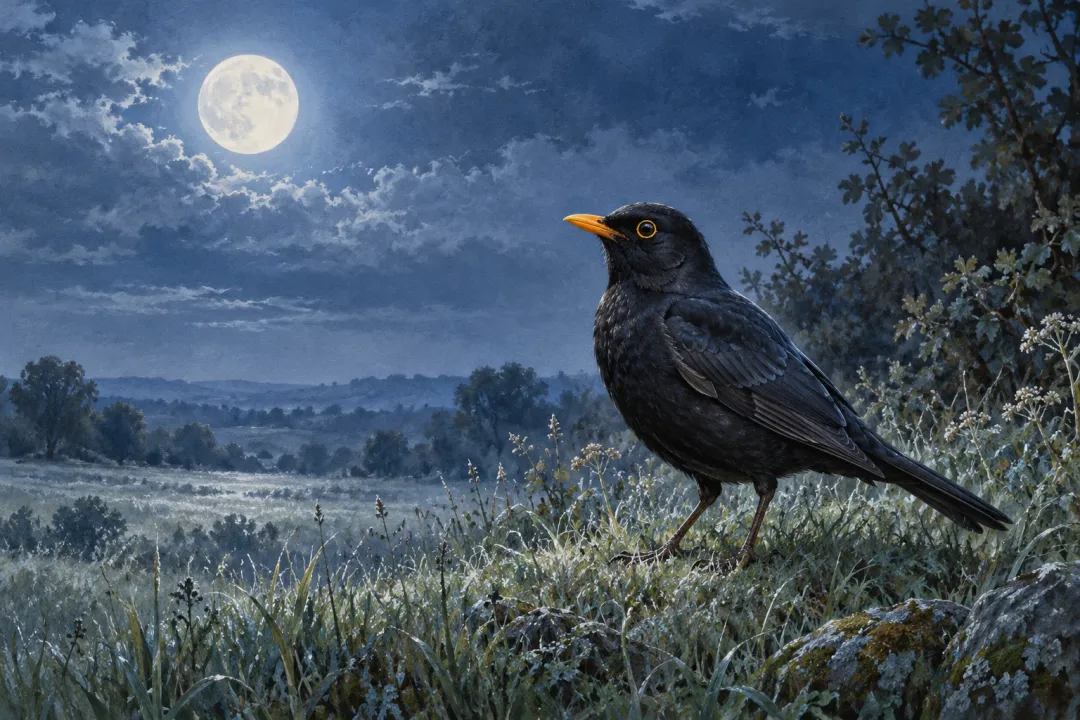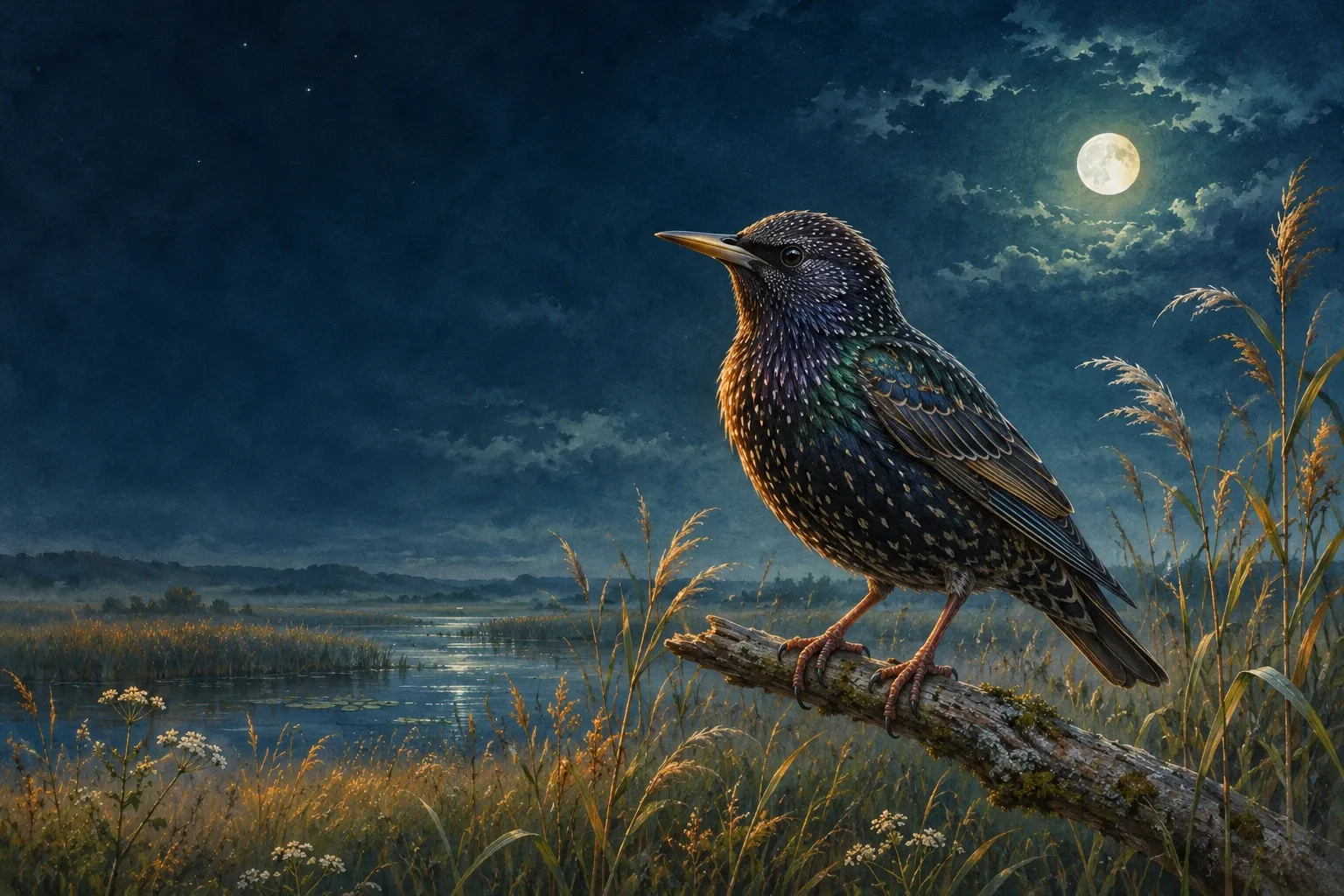
A starling can look black as a coal chip until sunlight catches its feathers and green and purple gleam across them. Then it joins thousands of birds turning together over a winter roost, each small shift traveling through the flock. The starling’s meaning gathers around those two acts: it changes with the light, and it moves in company. It teaches the art of belonging without losing your own bright color.
The starling’s many voices
A starling whistles, chatters, and imitates other birds. It can borrow a hawk’s cry or echo the quick sounds of a human world. That mimicry is part of how it lives among others, but the bird has its own voice too: a varied, busy song, rising from a wire or a tree while the flock gathers below.
When the starling comes close during a season of confusion, listen for the difference between adapting your words and hiding inside somebody else’s. The bird can speak in many sounds without ceasing to be a starling. Let it remind you to be clear about what you need, and careful about how your words land. In a group, good manners are a kind of communication: a pause, a turn offered to another voice, a small adjustment that lets everyone stay in the conversation.
A life among others
Starlings feed and travel in flocks, and gather in great numbers outside the nesting season. A murmuration wheels and folds as its members respond to one another. Seen from below, it can seem like one dark creature changing shape across the sky. Up close, it is made of individual birds, each moving and each affecting the movement around it.
If the starling has become a companion through life, its kinship is in this steady participation. You notice who has been left out, who needs a word translated into gentler terms, and when a sharp remark is about to turn a small disagreement into a flocking contest. Starlings themselves can mob other birds, so the lesson includes a warning: a crowd can protect, but it can also press too hard. Your place in a group carries responsibility for the space it gives others.
In a hard season, the starling’s message is to find your people and keep your own voice among them. When a task needs shared effort, call on the starling’s power: one small adjustment can change how the whole group moves. Speak plainly, listen for the answer, and take the next step together.
Color changing with the light
From a distance the starling’s plumage may seem dark and plain. Close by, light scattered from the feather surfaces reveals iridescent colors; in winter, pale spots mark the feathers. The bird changes in appearance with season and angle, without needing to become something else.
That shifting image gives the starling its spiritual meaning of transformation and personal gifts. There are parts of you that show only under certain light: a talent awakened by a new friend, a courage that appears when someone needs your help, a playful voice that returns after a long quiet spell. The starling asks you to notice what is already yours and let it be seen. Adapt to the moment, as the bird does, while keeping hold of the nature that carries you through it.
Branwen’s messenger
In the Welsh tale of Branwen, a starling carries a plea for rescue from Ireland to her brother, Bran. The bird’s small body bears a message across the sea, and its flight sets help in motion. In this story, the starling is a messenger whose voice reaches kin far away.
The tale gives the bird’s chatter a different weight. A message can matter because it is carried faithfully, not because its bearer is grand. When someone you love is distant, the starling’s story remembers the courage in sending word and the care in hearing it.
Starling dreams
A flying starling in a dream is associated with prosperity and support through a dark stretch. Its flocking life gives that image a particular warmth: help may gather around you as conditions begin to change.
A starling sitting in its nest carries a warning about a promise that may not be kept. A wounded starling points toward hurt in a relationship and uncertainty about what caused it. The dream asks for a careful reading of the injury before deciding what it means.
A starling landing on a rooftop brings news of someone finding a way through a vexing problem. At the doorstep, or entering the house, it signals a visit or a new romantic interest. These images keep the bird close to thresholds: word arriving, company appearing, and trouble beginning to lift.
The starling ends where it began: dark feathers catching a sudden spill of color, one bird among many, turning with the flock. Keep its image when you need to belong and still be yourself: a small bright voice carried across a wide sky.