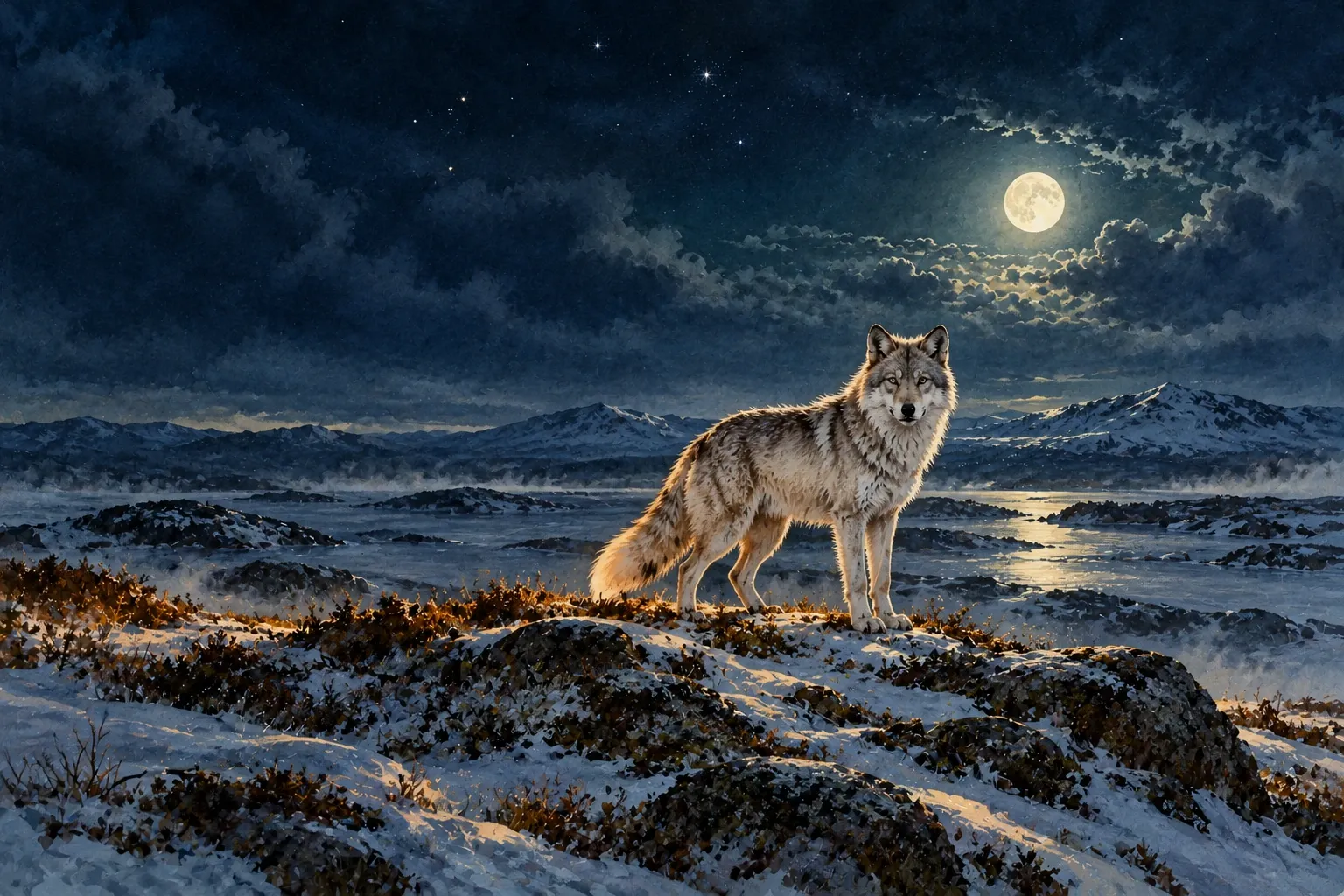
A hunter steps into the dark and hears nothing. Then a wolf-shaped giant appears, its dark coat nearly lost against the night. The Amarok hunts alone, with powerful jaws and a fierce hold on its territory. Its story turns on a plain lesson: know where your ground lies, watch carefully, and spend your strength when something truly matters.
The Amarok keeps its ground
The Amarok is a nocturnal hunter, massive beside an ordinary wolf and marked by a blunt muzzle, claws, and bone-crushing teeth. In the stories, it stays within its own territory. A hunter who wanders there at night may meet its attack, yet the creature does not range beyond its ground to pursue anyone. Its fierceness has a boundary: the giant wolf watches what enters its territory and answers a trespass with force.
When the Amarok comes to mind in a season that asks you to stand firm, let its territorial nature sharpen your sense of what matters. Name the value, promise, or quiet place that needs your protection, then hold to it plainly. A boundary is strongest when you know what it guards. The Amarok shows courage as a poised response, not a need to bare your teeth at every passing trouble.
The creature’s solitary hunt gives its silence weight. Real wolves live in family packs, while the Amarok hunts alone. Real wolves can hear rodents moving beneath heavy snow. That image of listening through deep cover suits the Amarok’s night hunt: small signs can matter even when the larger scene looks still. Real wolves can also smell prey from more than a mile away. Let that keen attention stand for gathering clues before you decide what a difficult situation means.
Real wolves use howling to keep track of one another, establish territories, and assemble the pack. The Amarok’s solitary nature gives its silence a different force: it can wait alone, watch the dark, and make its own move. Take solitude when it clears your sight; speak when silence would leave an important boundary unseen.
The strength to act at the right moment
The Amarok’s immense body, powerful jaws, and claws make it an image of strength that cannot be ignored. Yet the creature’s most useful power is not brute force alone. It hunts within its own territory, watches what enters, and acts with purpose. When a hard task calls for resolve, picture that lone night hunter holding steady before it moves. Its example lends courage for a clear decision, the stamina to endure a difficult stretch, and the self-command to avoid wasting force.
The Amarok’s dark coat helps it disappear into night, and its stories give it sharp sight, hearing, and smell. This is strength through attention as much as force: the creature moves in darkness where a careless hunter cannot easily see it coming. Let the image guide you through confusion by looking again at the small details: what has changed, what keeps returning, and where the pressure is coming from. Such attention can make a hidden way forward easier to see.
Some tellings imagine a white Amarok, its pale coat standing out against the dark and making it seem exposed. The image carries a different kind of strength: survival against the odds. The Amarok remains an enormous, solitary creature, whether its coat is dark or white. If you are setting out on your own, let its story lend you nerve. Move without apology when your path is yours to choose, and keep enough balance to return to the people who matter when your solitude has done its work.
When the Amarok appears in dreams
A lone Amarok may point to a period of solitude. The feeling in the dream helps distinguish chosen quiet from loneliness: the animal standing at a distance has a different weight from one that leaves you frightened and alone. Its presence can bring attention to how much time you spend apart from others, or to a need for more stillness before you act.
If the Amarok is hunting, the dream may turn your attention to what you are pursuing. It may also put a boundary in view: the animal is on its ground, or someone has crossed into yours. Consider what the chase is about and whether the pursuit respects the limits of everyone involved. The Amarok’s hunt asks for alertness about both your aim and your conduct along the way.
If you touch the Amarok or take hold of its ears, tail, muzzle, or another part of its body, the danger of a bite may suggest that something wild or unexpected is closer than you thought. If its teeth dominate the dream, the image may point to a task that has grown too large for the strength you have available. The teeth give the warning its shape; they do not foretell what will happen.
When the Amarok’s sharp senses stand out in a dream, the image may point to a situation where quiet signals matter. You may be trying to read gestures or what remains unsaid. Think about what the animal noticed and what became clear only after it appeared. Its night hunt lends the dream its particular counsel: listen closely and look for the signs that are easy to miss.
Carry the watchful image with you
The Amarok remains alone at the edge of its ground, its dark shape nearly lost in the night. It does not spend its strength on every sound; it watches until the moment calls for action. Keep that image when a difficult choice approaches: a great wolf standing still, certain of its ground, with its ears turned toward what the darkness has yet to reveal.