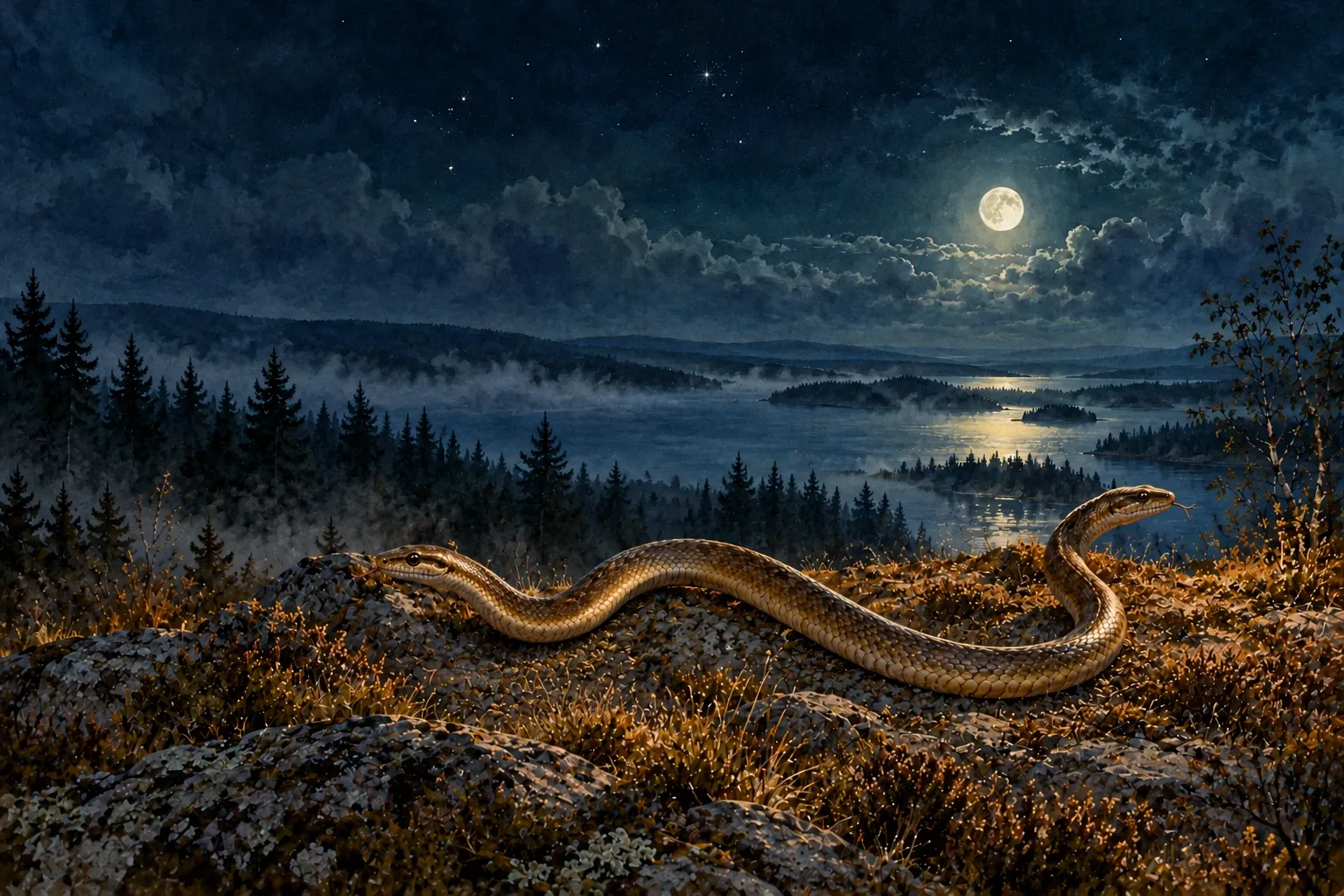
A head at either end gives Amphisbaena a view no ordinary serpent can claim. In the old imagination, it can turn and travel from either side, its long body following whichever head takes the lead. Its teaching is plain: see the whole choice, then let your life move in one direction.
When Amphisbaena helps you find your way
When a decision keeps turning you around, remember the creature’s two heads. Each end can lead, but one must take the front if the body is to go anywhere. Amphisbaena asks you to hear the truths pulling against each other, then choose which one will guide your next step. Its name, from Greek roots, means “walking both ways.” That old meaning gives the creature a natural place beside anyone standing at a crossroads.
Amphisbaena uses one head to lead while the other trails, then reverses their roles when it moves backward. That makes it a guide for the moment when a path calls for a change of course: look back with care, gather what the past has taught you, and then decide how to go on. The doubled body also speaks of cooperation. Its heads belong to one creature, and neither can travel far without the rest of it. When people around you disagree, listen for a pace everyone can follow. If this creature feels like an old companion, its mirrored shape belongs to a nature that can consider more than one side of a question. Keep a watch on your words, too: the serpent’s imagined venom gives sharp speech a lasting sting.
The old stories give Amphisbaena an unusual resilience. The serpent alone among serpents stands up to the cold and appears before the others. Take that as a strength when you enter unfamiliar or difficult conditions: hold steady, notice what the moment requires, and adapt without losing your direction. In its imagined healing lore, the creature’s shed skin and renewed body link it to recovery and the forming of new ideas. When you are beginning again, let the old shape fall away and carry forward what you have learned.
When a task needs fresh movement, picture the serpent winding into a circle. Its body loops as it travels. That image gives Amphisbaena a gift for getting past an impasse: one end can become the other, a turn can become a beginning, and two minds can share the work. The two heads can pull toward opposing purposes. Divided aims can keep a body still. When your own thoughts are locked in a standoff, name the competing directions and decide which one serves the life you are trying to build.
When Amphisbaena comes in a dream
An intact Amphisbaena with both heads can point to balance returning, or to satisfaction when two parts of your life begin to agree. If the creature is wounded or has lost a head, the image turns toward inner conflict: your thoughts or loyalties may be out of joint, leaving you unsure what to trust.
If it crawls across desert sand, the dream may call for a stretch of solitude and a private reckoning. Amphisbaena in a cold place can carry the chill of feeling excluded or sensing distance from someone close. If you cannot tell which end is its head, someone or something in waking life may be difficult to read; the uncertainty can come from words that have failed to make a clear path between you.
Notice which way the creature travels. One coming toward you points to a matter that needs to be faced directly. One moving away can mark a challenge or relationship you are not ready to take on. If it curls up and brings one head toward the other’s mouth, a head-to-head encounter may be forming, one that asks both sides to work out their differences. The rolling creature can also carry a warning that trouble is brewing. In each of these dreams, its doubled body brings the question of direction close: which end of the story is leading you now?
The two-headed serpent in old stories
Amphisbaena rises from the blood of Medusa, the Gorgon, as Perseus flies over the Libyan Desert. It is a serpent with a head at either end, a creature that can travel both ways. In later centuries, it takes its place in medieval bestiaries, where its two heads stand beside the puzzle of opposing purposes. Across these old tales, the image stays the same: a body held between two ends.
The creature’s legendary cold-hardiness made it seem set apart from other serpents, while its two heads made it hard to tell where one direction ended and another began. Its winding body offered another way to imagine the same puzzle. What looks like a dead end may still contain a turn; what seems divided may share one body and one life. That is a teaching of balance, though balance does not mean remaining forever between choices. The heads can look both ways, but the body must travel.
Amphisbaena leaves us with its long form bent into a living circle, each head close to the other and either one able to lead. It teaches you to look both ways with an open mind, then choose your direction. Once the two ends agree, the creature uncoils and carries its whole self onward.