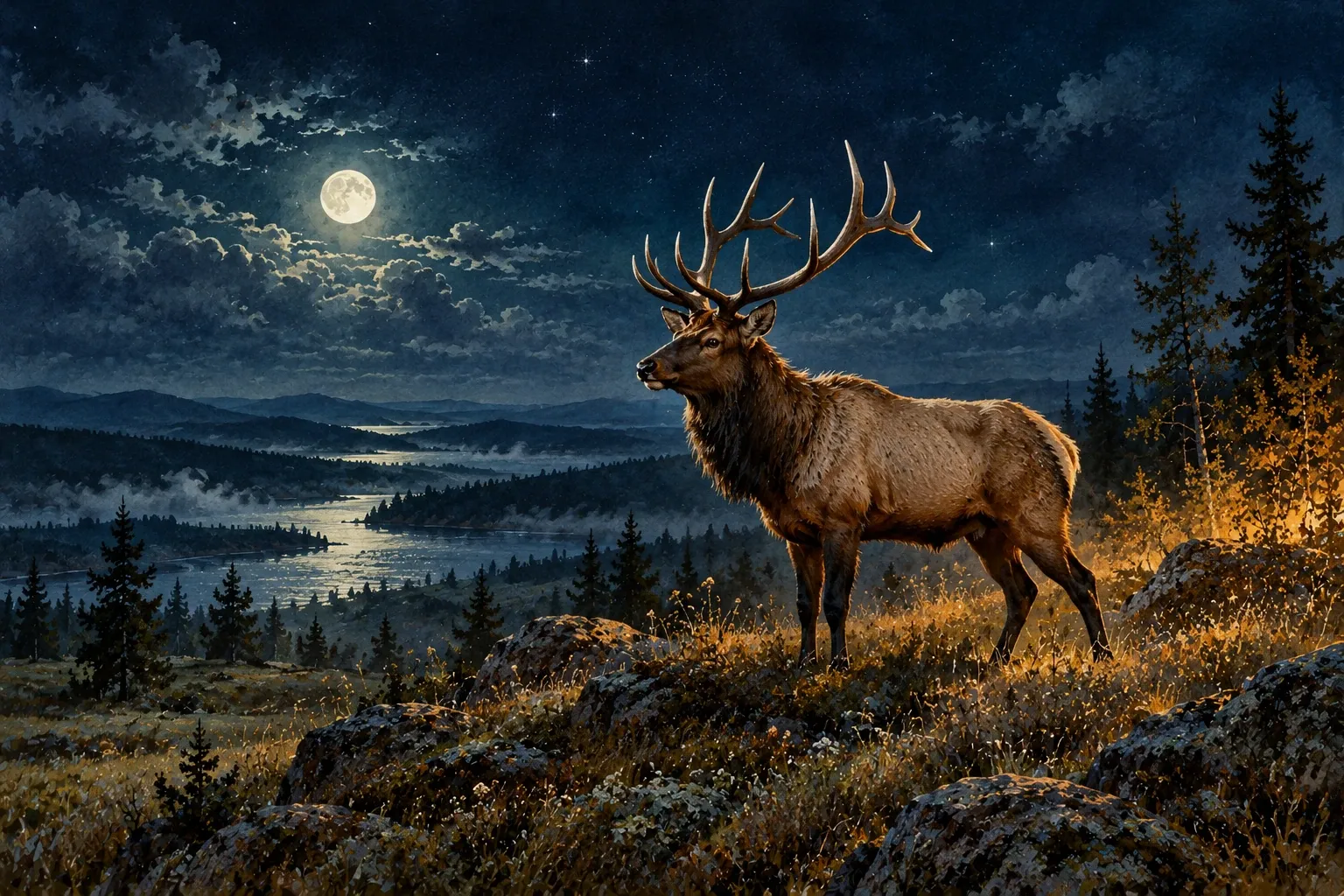
A bull elk lifts his head in the autumn meadow, and his bugle rolls over the herd. The sound carries his presence across the open ground, while the cows and calves remain close and other elk keep watch. There is room in that call for both strength and company. Elk teaches that lasting power is not spent all at once: it holds its pace, makes itself heard when the season comes, and stays connected to the lives around it.
The long road in the elk’s stride
An elk can keep a strong trot for a long distance. It takes four or five years to reach maturity, and the bull grows and sheds his antlers in an annual cycle. The animal’s strength is built through time, renewed season by season. Elk carries that kind of stamina: the work that matters often asks for consistency before it offers its full reward.
When elk enters a demanding season, take the length of the road seriously. Set a pace you can keep, and give the effort what it needs to last. If you have begun a project that matters, let it grow through its seasons instead of asking it to be finished by force. The elk’s stride is steady, but it is not timid. When a moment calls for you to be seen or heard, stand tall and make your voice carry.
The bull’s autumn call also reminds us that presence need not become a contest. Elk can be imposing, with a large frame and antlers, yet its power has work to do: courtship, defense, and life among the herd. Let your confidence protect what matters and give your purpose a clear voice. Strength is most useful when you can keep hold of it after the first hard day.
What the herd knows
Elk live in herds, often in groups of females and groups of males. Some animals keep watch while others feed. When danger comes, the adults defend vulnerable calves with their hooves. The herd’s care is practical: attention is shared, alarms travel, and the young are not left to meet every danger alone.
This is the elk’s lesson in kinship. A lifelong bond with elk belongs to a nature that can stand firmly on its own and still value the company of its people. Independence has a place, but it does not ask you to carry every burden alone. Notice who needs your watchful care, and let trusted companions stand beside you when the task is too large for one pair of shoulders.
In a hard season, elk keeps its people in view. If demands are piling up, call on the elk’s endurance and the herd’s shared attention: choose the next necessary step, keep a sustainable pace, and ask for help where someone else can carry part of the watch. If a loved one is exposed or vulnerable, the elk’s fierce defense says to be steady and present. Care is not always soft-spoken; sometimes it means holding your ground so the young or weary can remain safe.
The herd does not move as one unthinking body. Elk call, listen, watch, and respond. There is a place for your own voice and a place for hearing the voices around you. Elk asks you to be dependable in both roles: speak clearly when the moment calls for it, and stay attentive when someone else needs to be heard.
When elk comes into your life
A bull elk’s bugle belongs to a season of display and courtship; outside the rut, elk commonly gather in same-sex groups. Elk’s nature therefore holds both independence and companionship, a solitary strength within a social life. As a message for a particular season, elk points to stamina, the courage to be visible, and the value of being among people who understand you. As a lasting kinship, it speaks to the steady, protective character of the herd. When a task requires durability, call on the elk’s long stride: keep going without wasting your strength on haste.
Elk’s power is composed. The bull does not need to call at every hour of the year; the call rises when the season is right. Take that as a teaching in timing. Prepare quietly while the work is young, keep your effort consistent, and let your presence be unmistakable when it is time to act. For a long undertaking, the elk lends stamina. When respect has been withheld, it lends the courage to stand tall and speak plainly. When your people need protection, it lends the strength to stay close and keep watch.
Elk in dreams and Lakota tradition
The action of the elk in a dream matters. An elk that is running away can point toward a time when you are backing away from a necessary stand. It may also show how strongly you want to escape a pressure that feels too large. Look at what is happening around the animal in the dream: the danger, the distance, and what you are trying to protect all shape the meaning.
An elk that listens can turn your attention toward what you have not yet heard. In waking life, elk communicate through calls and signals, and watchful animals help keep the herd alert. A listening elk in a dream may suggest that you give the people around you your full attention before you decide what to do.
In Lakota tradition, elk is connected with love and courtship, and a bull elk in a dream carries a particular meaning. One Lakota legend tells how the elk owns the love charm. These meanings belong to Lakota stories and practice, with their own history and place; they are not a rule for every dreamer. The bull’s call across the autumn herd gives the story a vivid image: a voice raised to reach another, with longing and attention held in its sound.
Elk’s teaching returns to that meadow. The bull calls when the season is right, the herd listens, and the long stride carries them on. Keep your strength for the road ahead, and let it serve the lives you walk beside.