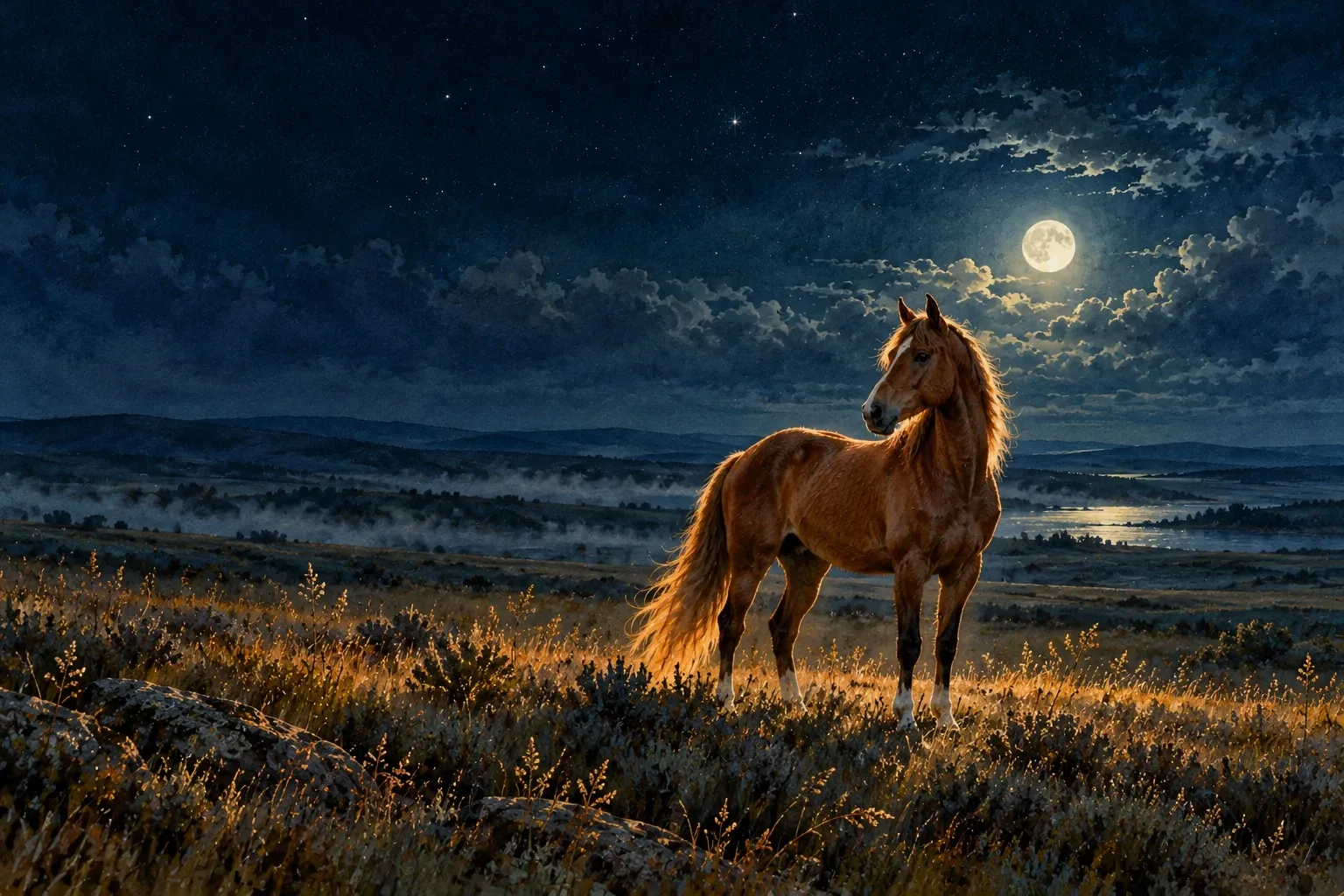
A horse can sleep standing, ready to flee at a sound, then travel for miles beside a trusted companion. Its wide-set eyes take in nearly the whole horizon; its strong legs carry it swiftly from danger. Yet people have also asked horses to pull, plow, and bear them across difficult ground. Horse holds these truths together: power needs room, and partnership can carry both companions farther. Its central teaching is to move freely with a steady, attentive heart.
Horse knows when the road is closing
When Horse comes to you in a season of confinement, look closely at what has become a tether. A horse made for movement loses something when its life is narrowed to service alone. The image of a horse held in a stable or tied up can point to restricted autonomy, dwindling energy, or a part of yourself kept under too tight a rein. Horse asks you to recognize the limit and find the strength to take a new direction.
That movement does not always mean a sudden gallop. Horses have the stamina for long journeys because they move at a pace the distance allows. They run, rest, and keep going. Their steady rhythm teaches that freedom includes knowing when to conserve strength, when to pause, and when the open ground calls for speed. A new path may ask for courage, patience, and attention to your own reserves.
Horse also knows the pleasure of moving with others. A horse lives among companions, forms lasting bonds, and communicates through its face and body. Its partnership with people has shortened distances and opened new ground, but trust asks for kindness and mutual regard. Horse teaches independence without isolation: keep your own stride, and honor the companions who travel beside you.
A lifelong kinship, and strength for the task
For someone who feels Horse as a lifelong kin, the animal’s habits make a durable guide. Its broad field of vision keeps it alert to what is around it; its sensitivity makes gentleness matter; its speed gives it a way to escape danger. Horse shows that strength does not have to harden into force. Sensitivity can sharpen judgment, while patience and confidence help power find its proper direction.
When a task calls for endurance or courage, Horse lends the image of a strong back carrying a traveler over a long distance. It has helped people cross land, work fields, and face peril. That history speaks to the reach of cooperation: joined in trust, two beings can accomplish what neither could carry alone. Horse asks for a clear destination, a steady hand, and room for the partnership to breathe.
Its presence can also mark a need to move forward. If you feel an urge to travel or explore and fear holds you in place, Horse brings stamina for the first stretch. If you are carrying too many obligations, picture the horse straining beneath a heavy cart; the load itself may need attention. The lesson is not endless effort. Horse knows the value of rest and the moment when running is the wisest way to survive.
What a horse may show in a dream
A still horse may suggest a pause for rest, contemplation, or planning. A prancing horse can point to measured progress in a project or relationship; a galloping one can suggest rapid change or hurdles being crossed with ease. Notice the pace: the dream’s horse gives motion a shape.
A wild horse may point toward freedom and play. A bridled or tamed horse can suggest energy gathered around a challenge that needs direct attention. If the horse pulls a cart, the image may speak of emotional burdens or of carrying other people’s problems. A horse that sniffs the air with ears raised may turn your attention to subtle changes around you.
A talking horse puts its words at the center of the dream. A toy or other inanimate horse may suggest that something unwelcome is entering through an unexpected opening. A white horse can suggest victory, strength, purity, or adventure; a brown horse may bring practical matters, physical well-being, or a need to rely on your grounded nature into view. These images can point in different directions, so the horse’s color and movement belong together.
Horse in distinct traditions
Celtic lore gives Horse a place among divine guides and protectors. Epona, whose name means “mare,” protects the Earth; Macha also appears in horse form. The Welsh Rhiannon rides a pale horse and governs fertility. These figures make the horse a sure-footed link between people and the spirit world. In other Celtic tales, a Pooka Horse lures travelers toward danger, a reminder that a road can be alluring and still lead astray.
Buddhist tradition associates Horse with prana, devotion, and the Dharma. One story tells that when Buddha set out on his life of asceticism, his horse realized it would no longer be needed and died of a broken heart. Tibetan spirituality gives the mythical Wind Horse a different expression: it represents the human soul and good fortune. In Chinese tradition, the Horse is associated with nobility, courage, and strength. These meanings speak in their own voices; together they show how the horse can carry devotion, good fortune, or a traveler’s spirit.
Christian scripture gives the horse a more unsettled image in Revelation’s Four Horsemen. White, red, black, and pale horses carry riders associated with conquest, war, famine, and death. The passage has also been read as an image of upheaval, judgment, and awakening. Here the horse’s power carries consequences as well as forward motion.
Horse does not tell you to race down every road. It teaches you to feel the ground, read the horizon, and know when your strength is best spent moving or resting. Picture a horse crossing open country, companions near, wind in its mane. Its stride carries freedom, and its steady attention keeps that freedom in balance.