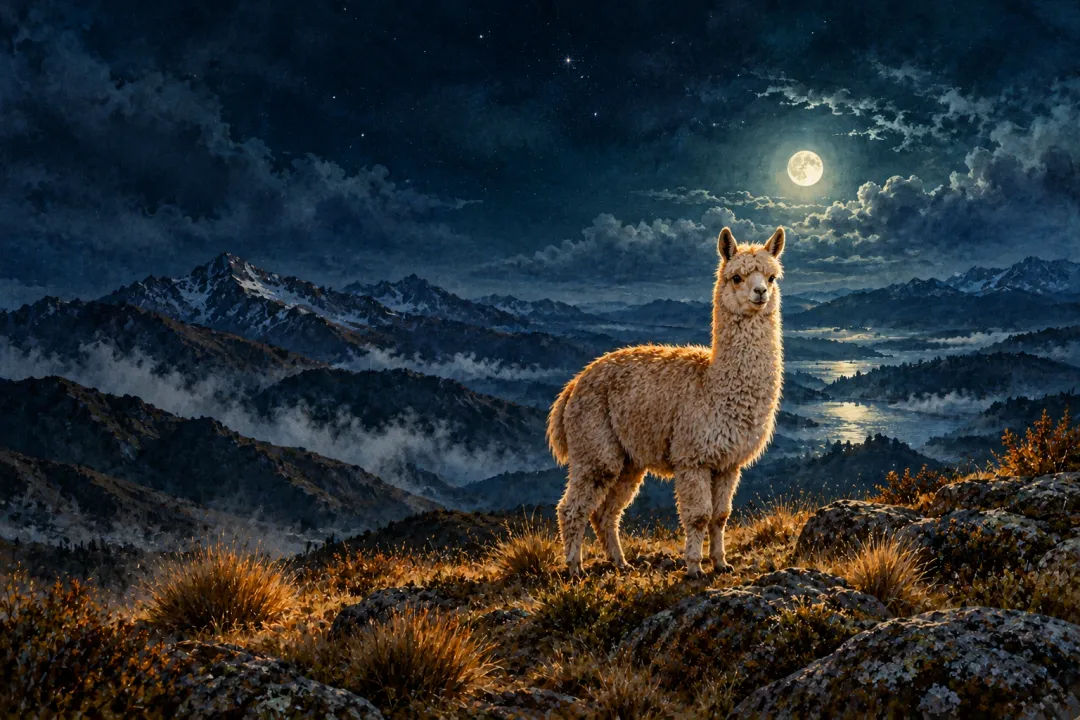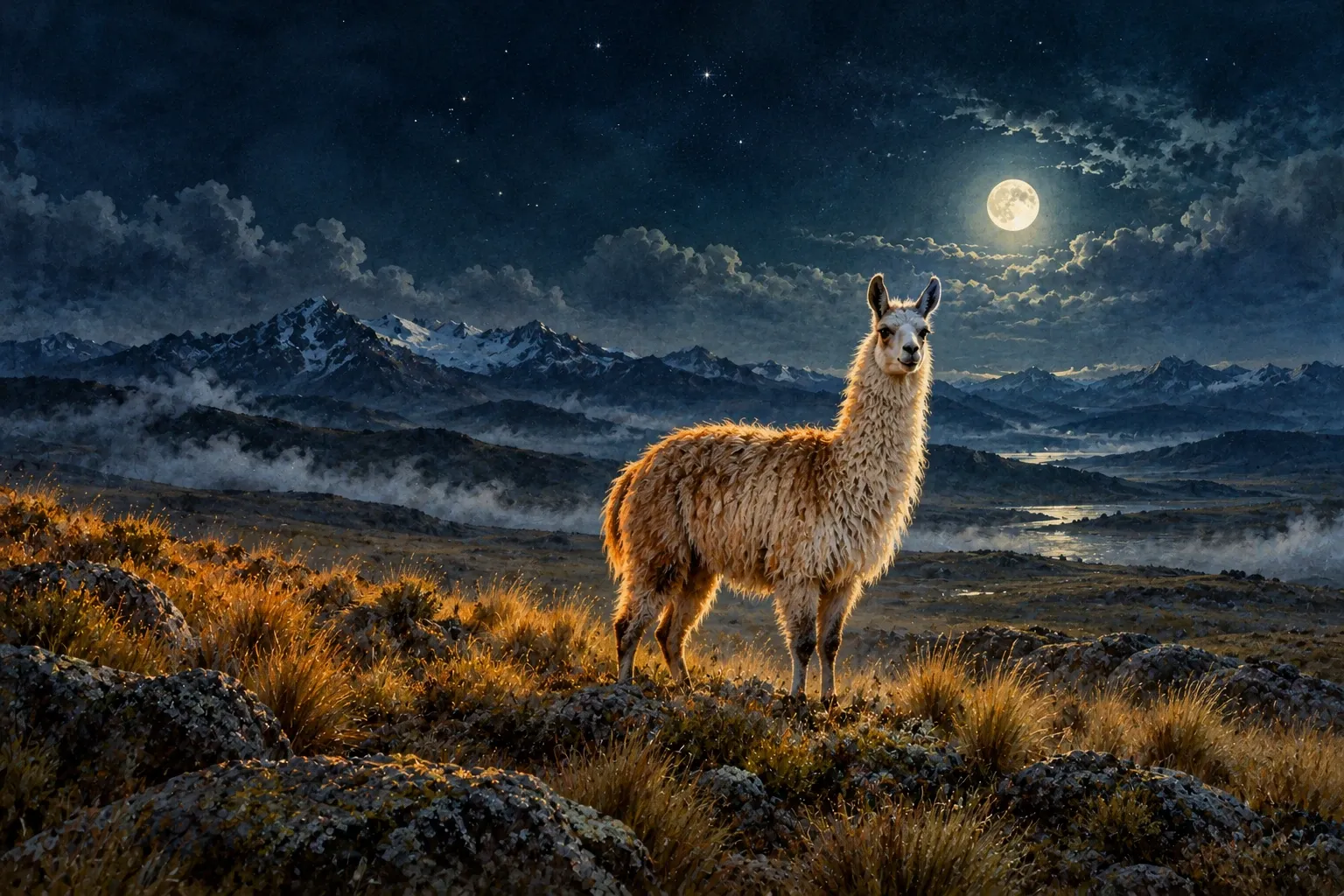
A llama picks its way along a steep Andean trail, placing each split-toed foot on the stony ground. It can carry a load for miles, yet when the burden grows too heavy, it simply stops. There is the llama’s quiet wisdom: keep going with patience, stay attentive to the people beside you, and speak when the weight has become too much.
The llama’s measure of strength
The llama’s strength is made for the long road. For generations, people in the Andes have depended on it to carry goods across rugged country. It grazes among highland grasses and shrubs, travels in a herd, and finds steady footing where the trail rises and breaks. This is not the strength of a sudden burst. It is the strength of many careful steps, each one carrying the journey a little farther.
When a llama enters your thoughts during a demanding season, look at the distance you have already traveled. A long task can make the end feel far away, but the llama keeps its pace over uneven ground. Take the next step with care. If your strength is running low, the llama has another lesson: a pack animal that will not move under an excessive load is telling the truth about its measure. You can do the same. Name what is too much, and put down what is keeping you from moving.
The llama is also plain in its speech. It hums among its companions, brays when something alarms it, and spits when it has had enough. Its displeasure is not hard to read. When you have been swallowing words that matter, borrow the llama’s bluntness. Say what you mean with a steady voice, especially when silence has let others mistake your patience for endless capacity.
There is affection in the herd as well as work. Llamas are social animals; they keep company and watch one another. Their gift is not solitary endurance, but endurance that belongs to a living group. Help where you can, and let others help you in turn. The llama’s kindness has a boundary: it stays close to the herd while keeping its own footing.
A companion for the road ahead
A llama is curious, sociable, and independent. It gives its strength to the herd and keeps its own footing, showing how a lifelong kinship with this animal holds both companionship and self-reliance. When others ask for help, remember how the llama stands firm when its pack is too heavy; offer what you can carry, and let the rest be set down.
On a demanding journey, the llama places one surefooted step after another across rough ground. It carries a share of the load for many miles, so its strength lends patience for practical work that must be done day after day. Keep your pace steady, and let the next step be enough.
Llamas carry goods that help their communities cross steep country. Their service has a plain purpose: move what is needed along the trail. When you take up a task for someone else, carry it with care, as the llama carries its pack; when the weight becomes too great, stop and make the load lighter.
The llama beneath the Andean sky
In Inca life, the llama carried goods and held sacred meaning. A llama could be buried with a noble to accompany and protect that person after death. Herders also honored Urcuchillay, a multicolored llama deity who watched over animals. The health of the herds mattered to the people who depended on them, so the guardian llama’s place was close to daily life.
The Inka saw animals in the dark spaces of the Milky Way, giving familiar lives a place in the night sky. In the Inka sky, the llama’s eyes are Alpha and Beta Centauri, and the figure includes a mother llama with her nursing young. The image makes the herd part of a larger order: mother and young held together in a river of stars.
A Peruvian flood story gives the llama a watchful voice. Seeing an omen in the sky, it warns a man to climb to the mountaintop with food. He follows its counsel, and there, above the rising sea, waits with the animals until the waters recede. The llama’s familiar alertness becomes protection: it notices danger, calls it out, and helps others find the high ground.
When a llama appears in a dream
A llama walking down a road can suggest trust in the path you have chosen and the resolve to continue. If several llamas travel together, the dream may point toward cooperation with people who share a purpose. The image is one of steady progress made in company.
A llama bent beneath a heavy load brings the question of measure into the dream. It can reflect too many responsibilities or old worries that remain packed on your back. A llama that spits may point to tension with someone who is displeased, or to words that have been held in too long. The animal’s direct signal asks you to face what has reached its limit.
A llama lying down can suggest a setback or a pause in progress. One dressed in bright or silly clothing may point to foolish behavior by you or someone near you. A white llama can carry the promise of companionship, prosperity, or a new journey; a black llama can bring an image of comfort or rekindled passion. If a wise person or elder walks with the llama, the dream may speak of learning and spiritual growth.
The llama does not hurry the mountain. It walks with its herd, keeps watch, and knows when its pack is too heavy. Picture it on the narrow trail, one sure foot finding ground after another. Carry what you can carry well, and let honest measure keep the journey open.