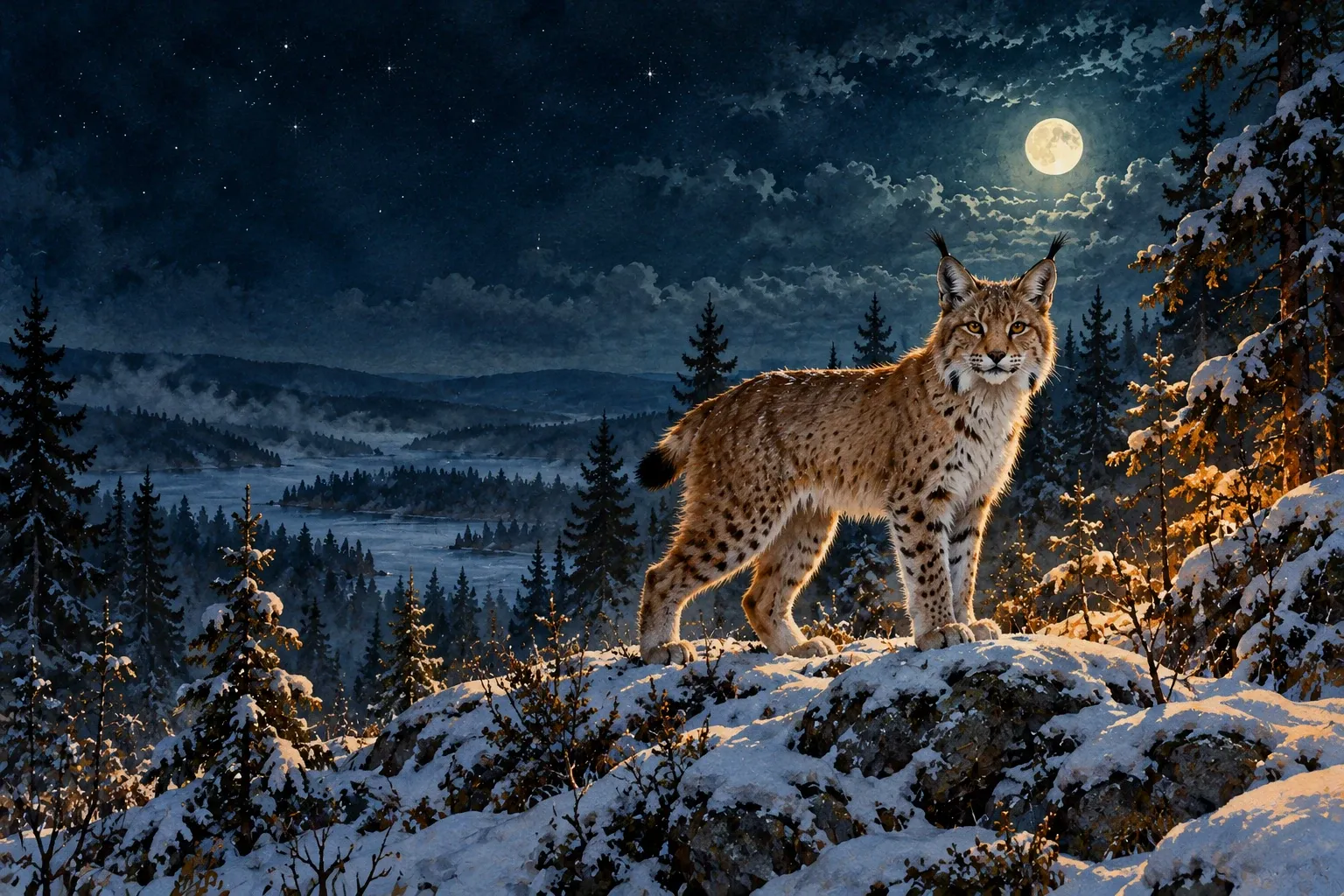
A lynx lays its wide, furred paws on deep snow and keeps moving where another cat might sink. Its ear tufts catch the smallest stir, its hearing turns toward what the eye cannot find, and its spotted coat lets it disappear among shadow and winter brush. This is the lynx’s old lesson: stay quiet long enough to see what is really there. Hidden things are not always far away. Sometimes they are waiting in a voice’s hesitation, a track across snow, or the stillness before the right moment to move.
The lynx sees what silence keeps
The lynx’s keen senses have long made it a figure of vision and secrets. It listens closely, watches without fuss, then acts with care. When this wild cat comes into your thoughts during a season of uncertainty, it asks you to slow down and look again. Notice tone as well as words; watch what people do as well as what they promise. A sweet manner can conceal a sharp purpose, and a first impression can miss the truth. Let your attention gather before you decide.
The lynx also knows when silence serves. A confidence shared with you is something to carry gently. This animal’s teaching is to hold what you learn, and to use insight with care. Seeing into another person’s fear or hidden ability does not give you leave to expose it. The lynx watches without turning every discovery into a story for others.
Its quiet has warmth in it, too. Lynx kittens wrestle, chase and climb as they learn the skills that will keep them alive. Their play is practice, but it is also a bright part of growing. The lynx reminds you to let a little lightness return when worry makes every hour heavy. A playful turn of mind can clear the view as surely as patient observation.
A lifelong eye for the unseen
For those who feel kinship with the lynx across their lives, patience is part of their nature. They may wait while others rush, then recognize the moment when an opening is real. They listen closely and often understand the meaning beneath a halting explanation. Their presence can make people feel seen through. That perception asks for humility: keep a confidence, and remember that what you sense is yours to handle responsibly.
The lynx’s solitude belongs here as well. This is an animal that moves alone through a wide northern range, following its own path over snow. A person who feels its enduring kinship may need quiet hours to recover their balance, even while remaining at ease among people. Independence can bring space for clear thought; it can also make the path lonely. The lynx teaches that solitude has value when it sharpens attention and leaves the heart able to meet others again.
When a task calls for discernment, call on the lynx’s particular strength. Its tufted ears and watchful eyes offer a fitting image for listening before speaking, reading a difficult situation, or guarding something entrusted to you. The lynx’s steps are deliberate, not timid. It waits because timing matters, then acts when the trail is clear. Let that be your strength when a decision needs patience, discretion, or a steady ear.
When the lynx visits a dream
A lynx in a dream points toward something held back: a secret, an unspoken worry, or words whose sweetness does not match their intent. The image can bring attention to gossip or to a confidence that could cause hurt if mishandled. Let the dream remind you to be watchful and discreet; it does not prove that anyone has done wrong.
If the lynx runs away, the dream carries a different feeling: a victory or fortunate turn may be approaching. A lynx pacing in place suggests impatience with a matter that needs time. Its restless steps do not hasten the season. The dream’s animal knows that some conditions must unfold before the next move is possible.
Lynx stories across traditions
Among the Blackfoot, lynx sightings were rare, and people sometimes called it a powerful bobcat. In Mohave lore, dreaming of a lynx signaled that the dreamer was a skillful hunter. Northwestern tribal traditions cast the lynx as a hunter and bearer of civility, while Northeastern stories gave it a villain’s role. These are distinct tellings, each with its own view of the animal.
Ojibwe, Shawnee, Cree and Algonquin stories tell of a Great Lynx or Water Lynx, a powerful being with features of dragon and cougar, including a long copper tail. It rules over water creatures and guards the copper of the Great Lakes. Taking that copper breaks a taboo and brings disastrous consequences. Here the lynx stands as a guardian whose strength protects a valued boundary.
Norse tradition links the lynx to Freyja, who rode into battle in a chariot drawn by lynxes and held the animal sacred for its instincts and vision. In Himalayan regions, the elusive cat’s winter coat blends into snow, earning it the name Ghost Cat and associating it with what slips from sight. Ancient Egyptian images give the war goddess Mafdet a lynx face; as protector of Ra and defender of sacred spaces, she stands against venomous threats and the chaos of Apep. These stories give the lynx different powers—battle companion, elusive presence, fierce protector—without asking them to become one universal teaching.
The lynx remains itself at the edge of the trees: broad paws on snow, ears turned toward a faint sound, eyes holding steady in the dim. It teaches that what is hidden asks for patience, and what is seen asks for care. Watch quietly. Keep faith with what has been entrusted to you. When the moment comes, step forward without a sound.