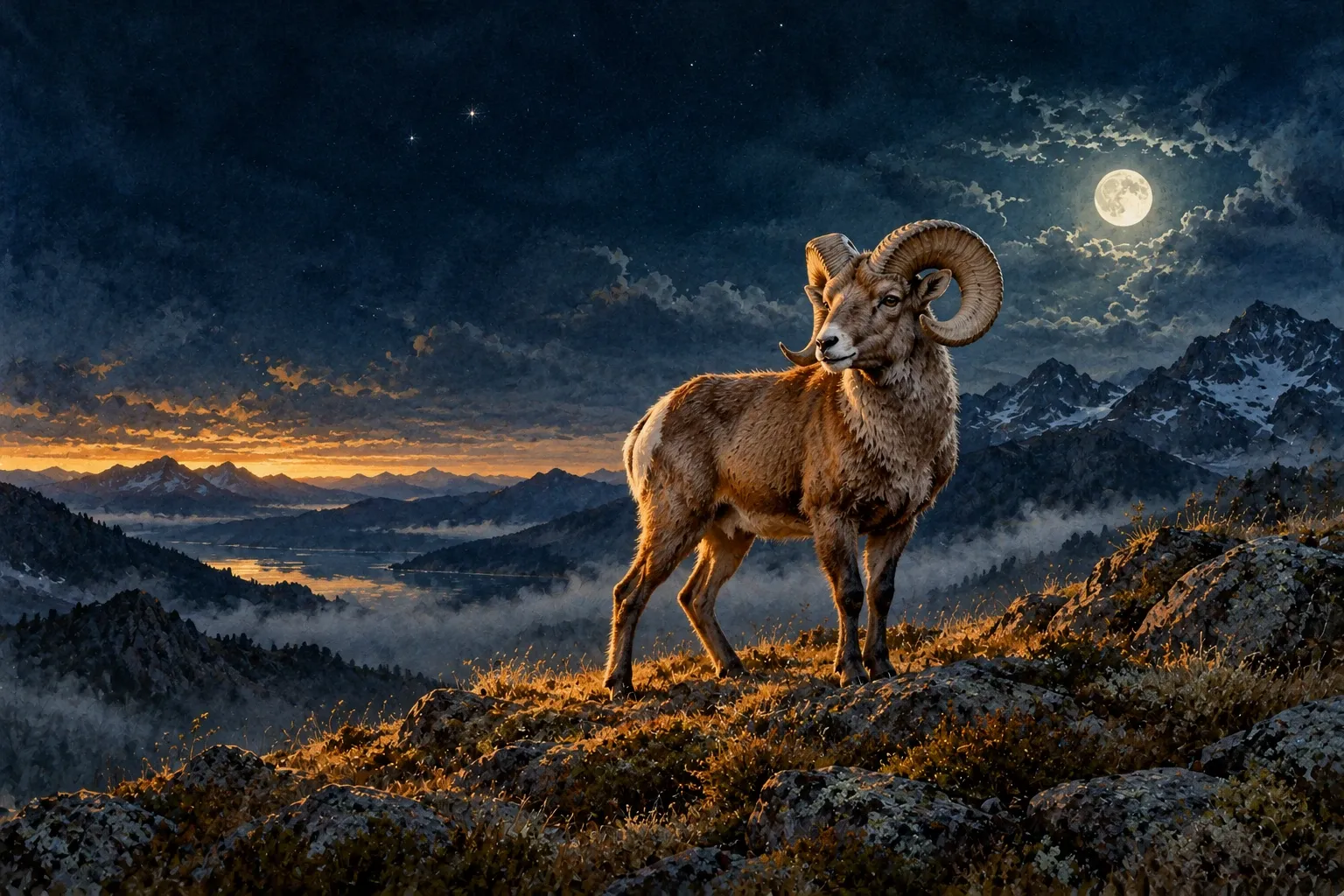
A ram can stand where the mountain seems to offer no room. Its hooves find a small grip on stone, and its weight settles there before it climbs again. That is the ram’s old lesson: a beginning can be narrow, a challenge can be steep, and still there is a place to put your feet. The ram joins boldness to balance. It does not spend its whole life charging; it knows how to hold its ground, test its strength, and climb toward the next height.
The ram’s way into a new beginning
A ram’s horns grow throughout its life, curling outward in a spiral. They are defense and display, but they also make a striking image of thought gathering force. The ram carries a lively mind, a growing imagination, and the energy to put an idea into motion. Its meaning is not simply to dream big. It is to bring the mind’s work down to earth, then take the first step.
The ram comes with the season of beginnings. In the western zodiac, it is Aries, the first sign of the astrological year, arriving with spring. In the Chinese zodiac, the sheep and ram are often treated as the same sign, associated in the supplied tradition with sensitivity and perseverance. These traditions give the animal different shades: the first turns toward initiative and vigor; the second toward persistence and quiet feeling.
When the ram appears at a turning point, it calls you to begin what you have been circling. A bighorn ram builds strength through the seasons, feeding and storing reserves for winter. Let its example steady a new effort: gather what you need, then move. The opening may be small, like the patch of stone beneath a hoof, but a sure first step can hold.
The strength to climb and to stand
Rams test one another in contests of strength, especially when rivals compete for mates. They spin, lunge, and clash their horns until one yields. Their power is plain, yet the lesson is not to turn every disagreement into a collision. The ram lends resolve for a hard task and the courage to meet a challenge directly. Its horns protect it; its footing keeps it from wasting strength.
The ram’s kinship belongs to people with active, curious minds, grand ideas, and a will to follow what catches their attention. Its nature can be stubborn and guarded, with a tendency to keep thoughts close. The growing horn offers a reminder: curiosity deepens with time, and imagination asks to be used. You can claim your ground without making every encounter a contest. Let the ram’s confidence carry you toward a demanding task, and let its sure feet teach you to keep your balance while you work.
On a steep path, a bighorn sheep can make a foothold in a space scarcely wider than its hoof. The ram’s strength, then, is also the strength to place yourself carefully. When life feels out of balance or you are entering unfamiliar ground, borrow that composure. Find one secure foothold, make the next move, and trust your ability to land.
What the ram brings into dreams
A ram standing in the foreground points toward leadership and the responsibility that comes with being seen. If it is black, the dream turns attention to ambition and the path you are choosing. A ram standing nearby can represent an important man in your life; if it seems agitated, the image connects with conflict and the need for reconciliation.
Catching a ram foretells overcoming a daunting obstacle. Being struck by its horns points to an argument ahead. These two images share the ram’s force, but they put you in different positions: one shows you gaining hold of a challenge, the other meeting its impact. A ram on a Friday night carries a more particular association with business advancement or professional improvement.
The ram in story and tradition
The ram has carried meanings of force, sacrifice, and the pursuit of great rewards. In the Greek story of Jason, the quest for the Golden Fleece makes the ram part of a heroic search. In biblical lore, the ram and lamb stand in sacrificial stories, including the Passover account. These are distinct traditions: the ram can mark the cost of devotion in one telling and the prize sought through a dangerous journey in another.
The battering ram gives its name to a force used to break through gates. It remains an image of direct action, but the living animal gives that force better judgment: a ram can charge, and it can also stand balanced on rock. Let the image of the ram on the ledge stay with you. Its horns catch the light; its feet hold fast. Then it climbs, one sure beginning at a time.