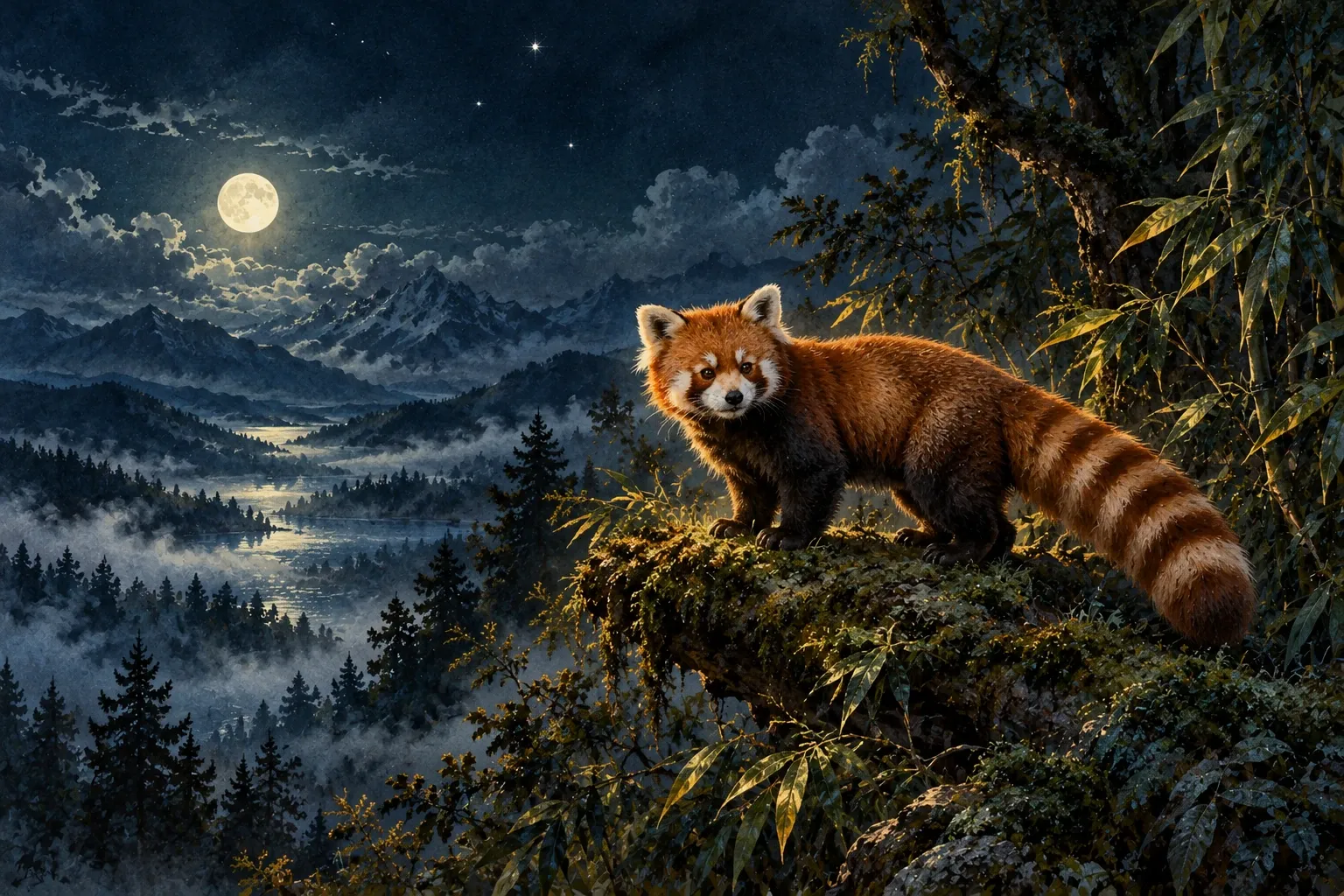
Among the moss and pale lichens of a mountain forest, a red panda’s russet coat nearly disappears against the branches. It grips the trunk and climbs down headfirst, turning its ankles to find a sure way. There is the red panda’s teaching: keep your own shape, and trust the small, practiced movements that bring you safely through a difficult turn.
A life among the branches
The red panda spends much of its life in trees, feeding on bamboo and resting to conserve energy. Its long, ringed tail helps it balance; fur covers its feet against cold. A false thumb helps it grip a tree, and its ankles turn so it can descend headfirst. Its dark fur and tail rings blend into the wooded backdrop. None of this is hurried or borrowed. Each feature belongs to a life made for high forests and narrow branches.
That life speaks of individuality without fanfare. The red panda is neither a small version of the giant panda nor a creature that needs to resemble its neighbors. It belongs to its own animal family, with its own markings, habits, and way through the trees. When other people’s expectations crowd around you, remember the animal moving along a branch: your path can be true to your nature, even when it looks unlike anyone else’s. The red panda’s distinctness is not a pose. It is simply how it lives.
The red panda is solitary for much of the year, yet it meets others of its kind in breeding season. It marks its territory with scent and keeps in touch through whistles and twittering. Its quiet life holds both independence and contact. Let your own quiet restore you, then share your time with people who meet you with care. Solitude is a place to gather yourself; it can also make your companionship more deliberate. A small circle can be enough, especially when each voice is welcome.
When the world grows loud
Bamboo gives the red panda little energy for all the time it spends eating, so it feeds through much of its waking day and rests to conserve what it has. It does not waste energy pretending to be built for another kind of life. When a hard season leaves you scattered, make a steady place to return to, and let rest have its honest share of the day. The animal’s pace offers a gentler measure than the noise around you. Its life is a lesson in tending what sustains you, one mouthful and one quiet pause at a time.
Its solitary nature also carries a message for a season of retreat. When demands have filled every hour, step away long enough to hear your own thoughts again. The red panda keeps to the trees, but it does not spend its whole life alone; take that as a reminder to come back toward trusted company when you are ready. Choose a small circle that respects your time and your boundaries. Like the red panda’s brief calls across the forest, a little contact can say enough.
When you need composure in a tense moment, think of the red panda holding its footing on a narrow branch. It does not solve a difficult passage by rushing. Pause before answering, and take the next step you can stand behind. The animal has more than one way to protect itself: concealment, a strong scent, and a sharp bark can each help it meet danger. Its example is not to meet every threat head-on. If an old arrangement has become hostile, its skill at finding a way down can lend you courage to leave with care.
The red panda’s appearance and habits do not follow the shape people might expect from its name. Let that be a strength when a task asks you to make something in your own fashion. Stay with the work as patiently as the red panda stays among the branches, and trust a way forward that fits your nature. Its false thumb finds purchase where a paw alone might slip; a small, particular strength can help you hold on through a demanding task.
The mother red panda tends her cubs for their first months, and the young eventually make their own way. This, too, belongs to the animal’s teaching: care can be close and attentive while it is needed, then give way to independence. If you are helping someone grow, offer what steadies them and leave room for them to find their own footing. If you are the one growing, remember that learning to stand alone does not erase the care that brought you there.
When the red panda visits a dream
A red panda in a dream can point toward worry that has grown larger than the trouble itself; its quiet presence suggests rest and a little play. The animal spends long hours feeding and resting, so its appearance can be a gentle reminder that a day cannot be made of effort alone. If several red pandas gather, the dream may speak of a time to come down from your familiar perch and seek company.
A red panda sitting with its eyes closed can bring attention to stillness. Give yourself a quiet moment to listen inwardly. When the animal appears upside down, the dream may reflect a life that feels unsettled, or a problem that needs to be seen from a new angle. The red panda knows how to turn itself around on a tree; your own next step may begin with changing your view. Its unusual position does not mean you have lost your footing forever. It may show that the way forward asks for a turn in perspective.
The red panda in Nepal and Sikkim
In Nepal, the animal is known by the name Nigalya Ponya, meaning “bamboo eater.” In Sikkim, the Sikkim Red Panda Winter Carnival takes its name from the animal and brings the state’s ethnic communities together to celebrate life and culture.
The Nepalese name follows the red panda’s daily life among bamboo; the carnival’s name carries the animal into a shared celebration. These are distinct ways of keeping it close: in a name shaped by what it eats, and in a festival that gathers many communities. The red panda’s own life remains quiet, tree-bound, and suited to its high forest home.
When the red panda finds its way down a trunk, headfirst and sure, it does not need the branch to become a road. It turns, grips, and descends one careful step at a time. Carry that image with you: a path can be unfamiliar and still hold firm beneath your feet.