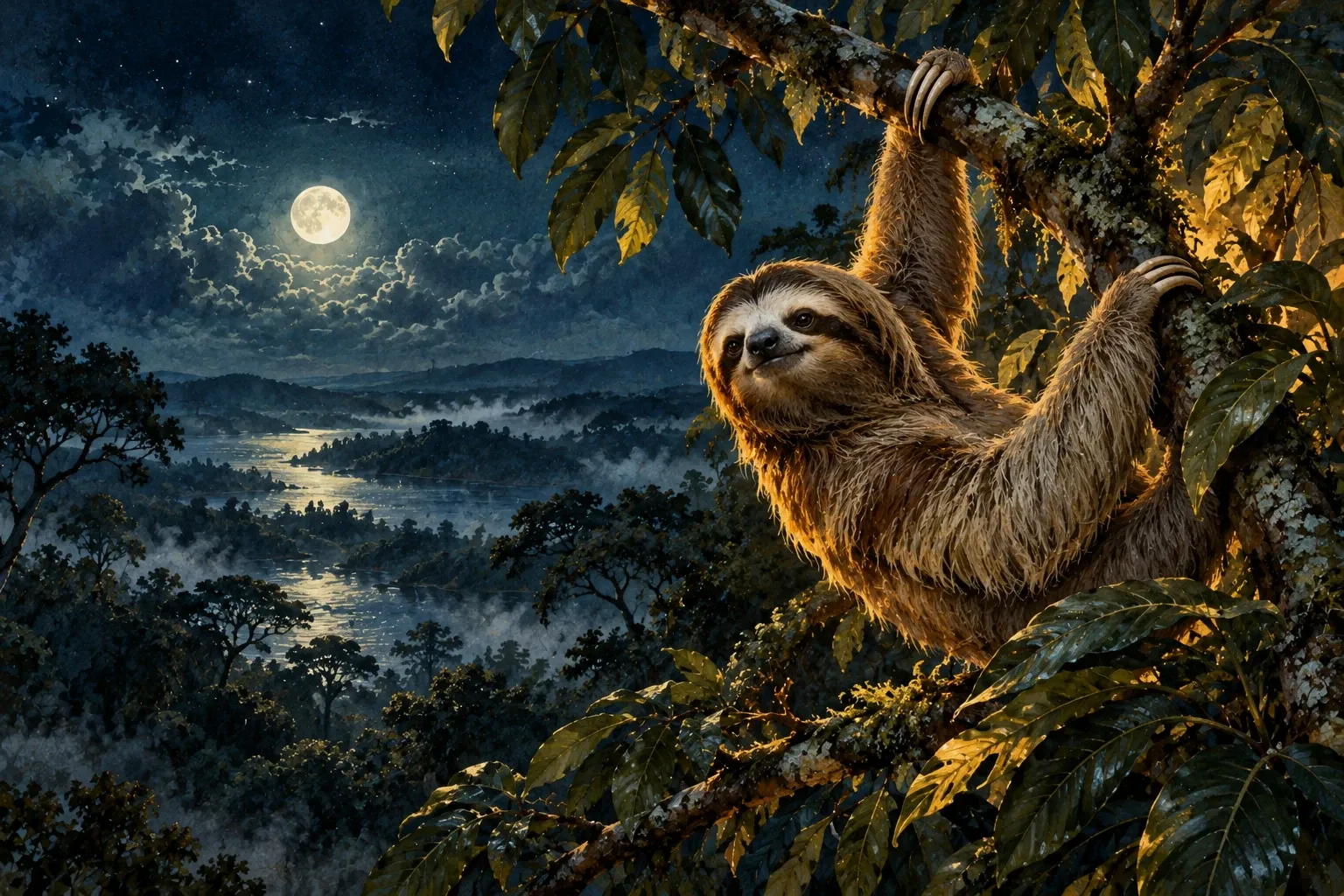
A sloth grips a branch with its long claws and travels through the canopy at a pace that lets the leaves seem to move around it. Its fur can take on a greenish cast from the algae living there, helping the animal blend into its leafy home. There is purpose in this quiet passage: the sloth conserves its strength, watches its surroundings, and keeps going without hurry. Its teaching is patience with purpose, and the wisdom of knowing when a small movement is enough.
The sloth’s quiet way of seeing
Sloth lives on a diet of leaves that gives it little energy, so its body is built to use that energy carefully. Its slow movement also makes it harder for a predator to pick out from the shifting canopy. What can look like idleness is part of how the animal survives. Sloth shows the strength in taking a measured pace, keeping your attention close, and spending effort where it matters.
From its upside-down perch, the sloth turns its head to look across its surroundings. Its view comes from an unusual angle, and it does not need to rush to take it in. When a problem has narrowed your sight, Sloth asks you to look from another position before deciding what to do. A new angle can reveal a way forward that force and speed would miss.
The sloth’s coat is a small living habitat, shared with algae, moths, and other creatures. Its life is bound to the canopy around it. This quiet relationship points to the support that can be found in one’s surroundings: the people, habits, and places that help you keep your balance. Sloth’s nature is reserved and peaceful, yet alert. It knows how to be present without drawing every eye.
When Sloth keeps you company
When your days have become crowded with urgency, Sloth comes with the reminder that steady effort still carries you forward. It moves slowly because its body conserves energy; follow that example in a hard season by choosing the next necessary step and saving strength for what follows. Rest belongs to the work of continuing. Let your pace fit the task and the energy you truly have.
Sloth also knows how to wait in cover. Its slow, gentle movements and coloring help it disappear into the foliage while danger passes. When a conflict is drawing close, keep watch from a safe place and let the moment become clearer before you act. If you do need to move, choose the movement that serves you instead of letting panic set the pace.
Some people carry Sloth’s nature as a lasting kinship. They may prefer calm company, thoughtful work, and a place behind the scenes; they take time to open up and do not change direction just because someone presses them. Sloth hangs upside down and sees the world from its own angle, so this kinship can bring an uncommon perspective. Your steady presence can support a friend through a slow change, and your way of looking may help others notice what they have missed.
Call on Sloth when a task has you rushing in circles or when a familiar approach has stopped working. The animal’s flexible neck lets it look around from its branch, and it swims well when it enters the water. That combination holds a practical lesson: conserve your energy, but stay able to adapt when the setting changes. A pause can help you see what the next effort asks of you.
Sloth’s gentleness is not helplessness. Its camouflage is one form of protection, and its quietness helps it avoid unwanted attention. The animal asks for restraint when restraint keeps you safe; it also reminds you to stay aware of what is happening around you. Patience works best when it includes observation. Notice the opening, the risk, and the moment when a careful response is due.
Sloth in dreams
A sloth hidden among branches carries the image of concealment. It may suggest that the time has come to step back, find cover, and watch before making yourself visible. A sloth fully exposed carries the opposite image: the animal is out in the open, and the dream may point toward greater assertiveness or a willingness to be seen.
A rigid sloth can reflect an ambition or effort that has stopped moving. The animal’s progress comes in small increments, so the dream may suggest beginning with one small step. If a sloth peeks toward you, its cautious gaze may bring attention to a person who could use gentleness or kindness. More than one sloth in the dream may point toward seeking help or inspiration from someone nearby.
A sloth lounging in a hammock or another resting place may speak to a wish for a break from pressure. The image of an animal at rest can carry the need to ease a pace that has become hard to sustain. If the dream leaves you feeling neglected, the sloth may stand for someone whose inactivity in a relationship is weighing on you. The scene matters: hidden, exposed, still, or watchful, each posture gives the dream its particular meaning.
Sloth in Amazonian stories
One Amazonian story tells of the Mapinguari, a fearsome creature said to roam the forest. Its form changes from telling to telling, with a bear-like body, backward feet, or a monkey’s face. Some versions connect this monster with the memory of giant sloths that once lived in the region. The story gives the quiet forest another shape: a place where an animal’s hidden presence can grow into a powerful tale.
A Brazilian tale tells of a sloth who borrows food from a mouse, snake, boar, and jaguar, promising to repay each one the next day. When the animals return, the sloth pretends to be ill. They gather beneath its bed, and their quarrel grows until each turns on the next. The sloth slips away quietly, leaving the jaguar to search for repayment. In this tale, concealment and clever timing carry the sloth out of danger.
The sloth’s own story remains simpler: claws holding fast, a leafy meal taken slowly, and a body blending into the canopy. It does not spend its strength to prove it has strength. It keeps its place among the branches, watches the forest shift around it, and makes its next movement when the moment is right.