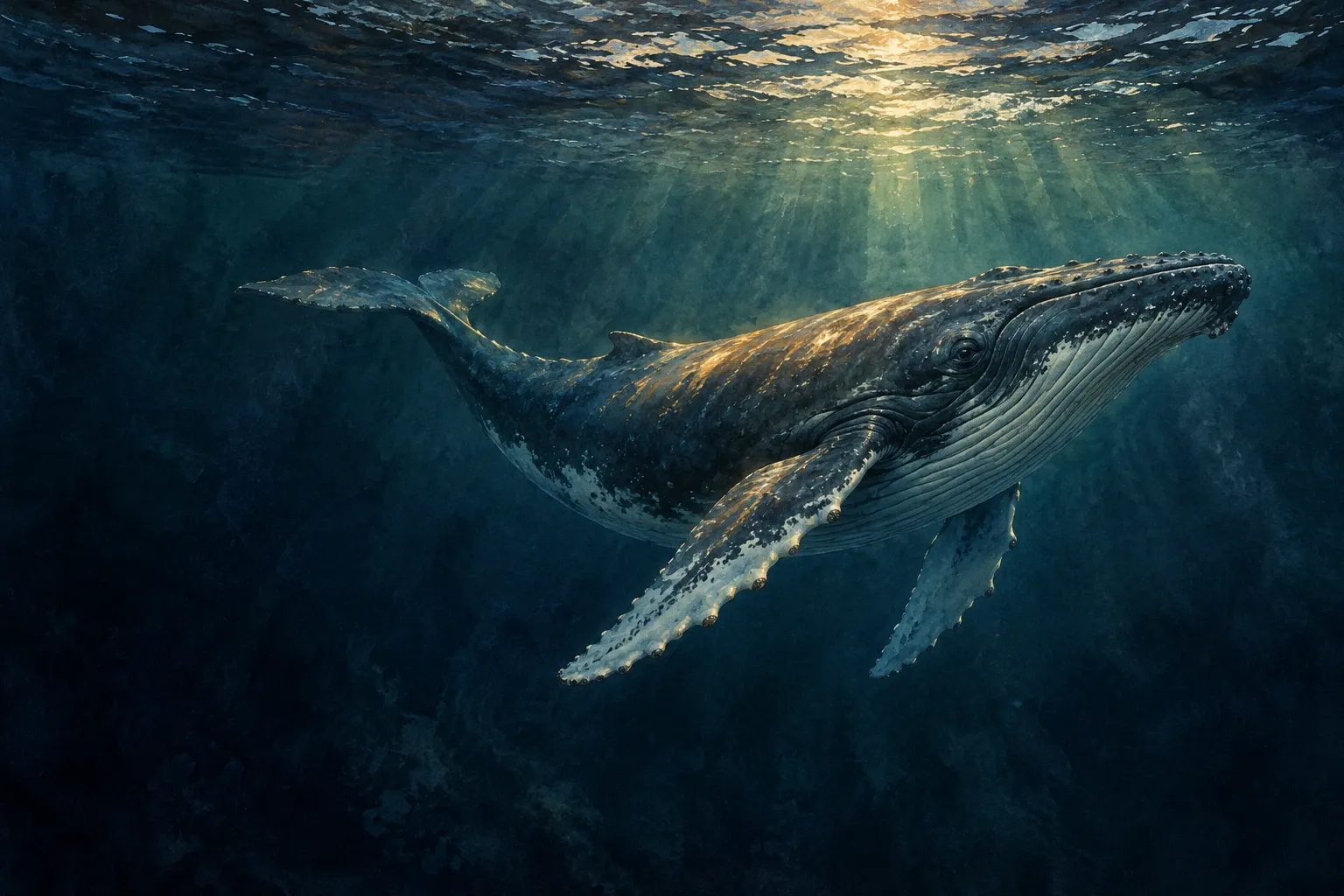
A humpback’s song travels through dark water, gathering distance until another whale hears it. Then the singer rises, breaks the surface, and breathes. Whale carries that rhythm into human life: enter the depths of feeling, listen for what is true, and return with a voice the world can hear.
Whale’s meaning lives between depth and breath
A whale belongs to the sea and must still come to the surface for air. It can descend into pressure and darkness, then rise into light. That passage makes Whale a teacher of inner depth and renewal. When life presses hard, Whale shows how to endure the deep stretch, keep your strength, and come up for breath when the time is right.
The whale’s immense body speaks of power, but its long migrations and measured gliding carry another lesson: great strength does not need to hurry. Whale asks you to slow down, feel what is moving beneath the surface, and trust the knowledge that grows in quiet. The ocean holds more than the eye can see; so does a human heart.
Sound is another part of Whale’s meaning. Humpbacks sing, and whales use sound to communicate and find their way through water. Whale reminds you that your own voice can reach farther than you know. Make something from what you have carried inside. Let a song, a truth, or an honest word rise out of the depths and travel.
Whale keeps a long memory of belonging
Whales live in close social bonds, and some remain with their mothers and family groups for life. Their calls can cross great distances. In this kinship, Whale teaches loyalty, care, and the strength of staying connected even when loved ones are far away. A Whale totem carries that steady sense of belonging: the heart knows its people, and the voice can find them across distance.
When Whale comes as a spirit guide during a difficult season, it lends composure under pressure. You can draw a deep breath, wait for the right opening, and recover clarity without denying the weight of what you feel. When you need strength for a task, call on Whale’s song: give form to private creativity, speak past shyness, or find the calm to move through a tangle of emotion. Whale’s gifts are depth, endurance, expression, and compassion for the living world.
What whales mean in different traditions
Stories of Jonah place a man inside a whale for three days before he returns to the world with a changed course. The whale’s belly becomes a place of silence, enclosure, and second birth: a passage through which a person can emerge with renewed purpose.
Among the Inuit, one bowhead legend honors the whale as the Great Spirit’s most magnificent creation. For Arctic peoples whose lives depended on close knowledge of the natural world, the whale was also bound to survival. In Pacific Northwest traditions, the Haida honored Orca as a powerful being that could take human form beneath the water; they said those who drowned joined Orca in its house under the sea. The Kwakwaka’wakw placed Orca at the head of the sea’s order, while the Tlingit of southern Alaska held that Orca did not kill humans and did not hunt it.
Vietnamese tradition regards the whale as a benevolent protector of people in danger at sea; communities have honored a whale’s death with a shrine and funeral. In an East African story, King Sulemani asks God to feed everyone on earth, and the whale consumes his crops before asking how he could feed such an appetite. The encounter teaches the limits of even generous ambition. These traditions hold their own meanings, from kinship and protection to awe at powers beyond human command.
When Whale visits your dreams
A whale’s appearance in a dream may bring a powerful feeling or change rising from the unconscious. Its size can suggest strength you have not yet brought to the surface. A dream of a blue whale may point toward a large emotional matter, love, or healing; an orca may bring questions of loyalty, protection, and the journey ahead. A whale may also touch feelings about a mother, maternal care, or a longing for nurture.
If only the whale’s tail appears above water, something important may remain beneath the surface of a decision. The tail moving along the waterline can also suggest balance between conscious thought and deeper feeling. If the dream recalls Jonah’s time inside the whale, it may point toward a passage that asks for stillness, help, or a changed direction. A stranded whale carries the stark image of a great creature unable to move where it belongs, a dream of constraint or a turning point that feels difficult to reverse.
Let the song rise
A whale does not leave the deep behind when it surfaces. It carries its old songs through the water and sends them outward, calling across the miles. Remember that immense body gliding below you: patient in the dark, faithful to its breath, and ready to break the surface. Go deep enough to hear your own song, then let it rise.