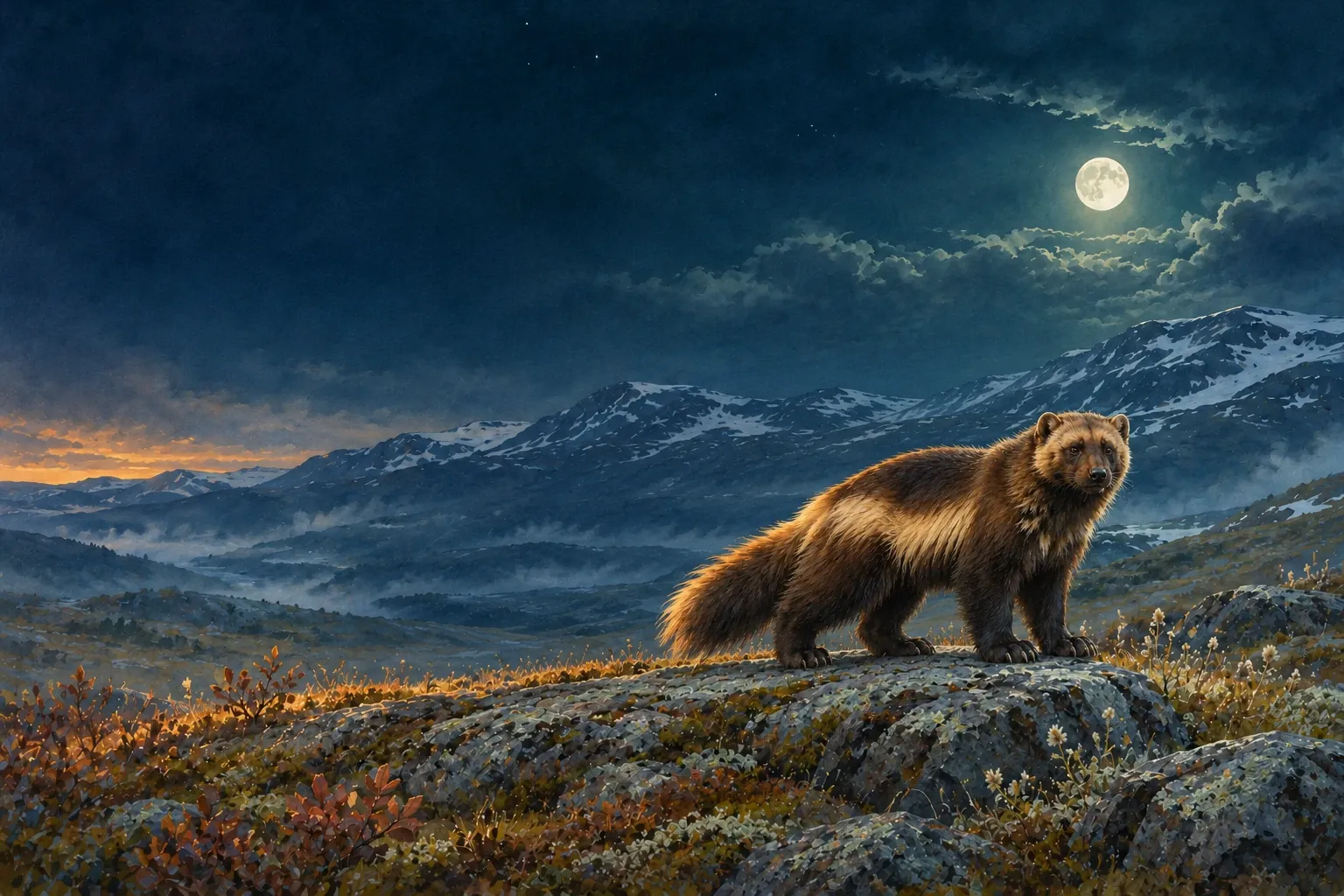
A wolverine leaves tracks across deep snow where the crust gives way beneath lighter feet. Its broad paws carry it through a cold country in search of food, and its thick fur guards it from the frost. It is a small, muscular animal with a stubborn claim on its own life. Wolverine’s meaning begins there: endure what is difficult, adapt to what changes, and keep enough judgment to know when a fight is worth having.
Wolverine knows how to endure
The wolverine travels far across tundra and forest, scavenging what other animals leave and hunting what it can catch. It does not depend on one easy meal or one kind of ground. Its strength is a working strength: persistence joined to adaptability. When the path grows hard, Wolverine says, look for the next foothold and keep going.
There is a sharp edge to that lesson. A wolverine defends itself and its territory, even against larger animals, but courage is not the same as charging at every threat. Wolverine teaches you to judge the strength of the other side and consider retreat first. You can hold your ground without spending all your strength on a contest that serves no purpose. Keep your intention clear; let your actions be deliberate.
Wolverine’s solitary nature also gives its strength a quiet side. It moves through a wide home range largely on its own, alert to what its senses can tell it. When you are in a season of uncertainty, Wolverine’s story is one of self-reliance: gather what you need, study the ground, and move with care. Its confidence does not come from being untouched by hardship. It comes from meeting the conditions it finds.
The strength to stand your ground
When Wolverine comes as a guide for a difficult season, it brings grit for a confrontation or a change that asks you to become more resourceful. This animal has powerful jaws and a body built to keep moving through snow; let that be a reminder to draw on what you have, even when the conditions are poor. Be direct about what you mean, and do not confuse a loud display with strength.
A lifelong kinship with Wolverine belongs to someone who feels at home outdoors, prefers a little space, and stays hard to pin down. The wolverine leaves its own scent marks and ranges widely through its territory; its nature is independent, alert, and unmistakable. Its musk has earned it the name “skunk bear,” but the animal does not need to announce itself with a performance. It simply carries its own character. Let your oddness be part of your nature, and keep your private thoughts in trusted hands.
When a task demands courage, call on Wolverine’s fierce persistence. It can lend the will to continue when you feel outmatched, along with the discernment to withdraw when that is the wiser move. The animal’s example is not mindless aggression; it is survival in a hard land through strength, patience, and attention.
Innu stories of Kuekuatsheu
Among the Innu, Kuekuatsheu is the wolverine: a trickster known for schemes, comic misbehavior, and stories that can turn on the teller as readily as on anyone else. His humor is part of his character. He is not a universal emblem for all Indigenous peoples, but a figure in particular Innu stories, where his mischief can bring trouble and entertainment in equal measure.
One Innu story tells how Kuekuatsheu and Mink made the world as an island after a great flood. Wolverine builds a boat to save the animals, then Mink dives repeatedly for earth to help make land. Wolverine’s place in the tale is not that of a solemn, flawless hero. He acts, gets tired, calls for help, and shares the work of making a world where life can begin again.
In a Dene story, Wolverine was once a man who tried to kill his mother-in-law. Her children took revenge on him and his family, though the young wolverines survived. They promised to leave traplines alone in exchange for peace, but the children broke their promise. Wolverines have taken bait and trapped food ever since. The tale gives the animal’s clever scavenging a history shaped by broken trust. These stories belong to distinct peoples and traditions; each gives the animal a different character.
When Wolverine appears in a dream
A snarling wolverine can point toward a decision that calls for confidence. Its fierce face asks whether you are ready to make the choice in front of you. If it is eating, the dream turns toward appetite and unmet wants: the animal takes sustenance wherever it finds it, and the image asks what you have been leaving unfed in your own life.
A wolverine trekking through woods suggests a journey or a change of direction, with new openings along the trail. One darting unpredictably through a dream may echo an inconvenience that arrives without warning. If you strike the animal, the image warns of impatience or a struggle to let events develop at their own pace. If you chase it, the dream can carry disappointment or restlessness; if it chases you, news may be on its way.
A wolverine half-hidden in darkness brings the animal’s elusive nature to the fore. The dream may speak of keeping personal matters close while trust is uncertain. And if it tells a funny story, take the laughter seriously: Kuekuatsheu’s mischief leaves room for play, and a hard season need not be all grimness.
Wolverine’s tracks disappear beneath windblown snow, but the animal keeps moving across the country it knows. Carry that image with you: persistence means finding the next step, and strength means knowing when to take it.