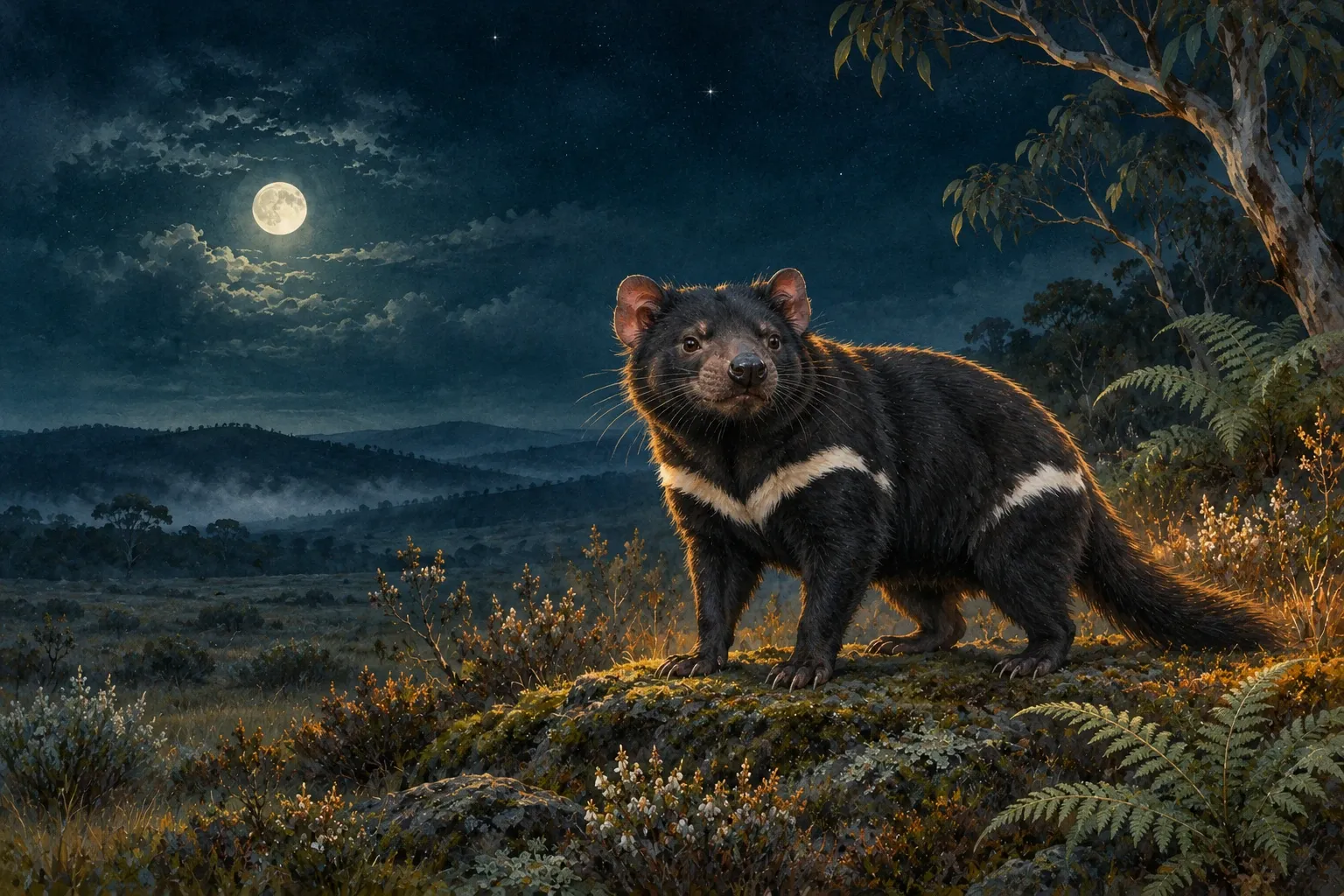
A Tasmanian devil’s cry can ring through the night, sharp enough to make a listener turn toward the dark. Then the sound falls away, and the animal slips back beneath dense cover or into a familiar den. It lives by both gestures: make yourself heard when something matters, and keep a safe place where strength can gather again. The devil’s meaning is fierce, but it is not a lesson in endless fighting. It is a lesson in using your voice and force with purpose.
The voice that carries through the dark
The Tasmanian devil is the world’s largest surviving carnivorous marsupial. Its stocky body, black fur, pale chest markings, and powerful jaws give it a memorable shape, while its snarls and screams can make a gathering sound more dangerous than it is. Devils often feed together at a carcass, where noise and display help keep others at a distance. The voice is part warning, part boundary: here is my place at the meal; do not mistake my quiet for weakness.
Long whiskers help the devil feel its way toward food in darkness, and its keen nose follows what the night conceals. It scavenges readily, eating what another creature has left behind as well as finding food for itself. There is a practical kind of wisdom in that habit. The devil does not waste its life insisting that every meal arrive in the same form. It notices what is available and makes use of it.
When a message has been swallowed by hesitation or muddled by too many words, the devil stands for plain speech. Say what matters clearly. Its cry carries, but a voice with force also has consequences. The animal’s lesson includes restraint: let anger tell you that something needs attention, then choose words that do not wound the very people you hope to reach.
The devil’s fierce and resourceful nature
When the Tasmanian devil spirit animal appears in a hard season, it brings the courage to face conflict and the judgment to pause before rushing in. A devil can bare its teeth, growl, and defend its place; that fierce display does not mean every encounter must become a battle. Let the animal’s warning sounds remind you to find out what is happening before spending all your strength on it. Get the facts, cool the heat, and speak so your meaning can be understood.
A lifelong kinship with the devil carries its directness and quick resourcefulness. This is an animal that finds food by scent and touch, uses what is at hand, and can make itself impossible to ignore when challenged. Its nature lends a clear eye for the heart of a problem, especially when confusion has gathered around it. The same blunt force can startle others, so let your words be as useful as the devil’s warning call: strong enough to mark a boundary, measured enough to let the moment pass.
When a difficult task asks for resolve, call on the devil’s strength to hold your ground and keep moving. Its powerful jaws speak to force; its flexible scavenging speaks to adaptability. Take the next necessary step, protect what matters, and remember that a den is part of the devil’s survival too. Courage can be fierce and still know when to return to shelter.
The den beneath the daylight
By day, the Tasmanian devil shelters under dense vegetation or in a den, often returning to a secure place over time. Caves and thick grasses can provide cover. That hidden home gives the animal’s meaning a quiet foundation beneath all its noise: security, boundaries, and the chance to recover beyond the reach of every demand.
The devil also has more than one way to meet danger. It can climb or swim, blend into surrounding brush, and release a strong odor when threatened. Each response belongs to a different moment. Sometimes survival means standing firm; sometimes it means disappearing from view or leaving by another path. The animal reminds you to protect your energy with the response that fits the trouble in front of you.
In Tasmania, the devil has become an emblem for groups and organizations, and its image draws visitors from around the world. It is a recognizable island animal, but its meaning reaches beyond a fierce reputation. Its voice, den, and resourceful feeding all tell the same story: strength lasts when it has boundaries and a place to return to.
When the devil enters a dream
A Tasmanian devil in a dream can point toward anger—your own or tension around someone close to you. Its growling presence asks you to look at what has stirred the conflict. The devil lives by keen senses and quick reactions; in the dream, let that alertness serve careful attention. Learn what is happening before acting on the first account you hear.
If the devil has its back to you, the image suggests a feeling or fear you have turned away from. The animal usually keeps itself sheltered when the day is bright; its turned back can bring attention to what you have hidden from view. If it cries loudly, something precious may need a clear defense. Let the cry sharpen your words, not turn them into a threat.
The Tasmanian devil moves through darkness by scent, whisker, and sound, finding what it needs in a world it cannot fully see. It calls when it must, changes course when danger comes, and returns to the den when the day asks for quiet. Carry that picture with you: a small dark shape beneath the grass, listening, then lifting its voice across the night when the moment truly calls for it.